Embedded partners: Industry-driven experiential learning directly on campus
June 28, 2026

Since its founding, Northeastern University has fostered student-industry collaboration through co-op and experiential learning programs as a central tenet of its approach to education. The Vancouver campus builds on this tradition in new ways through its innovative embedded industry partners program.
Through this initiative, the campus hosts 70+ companies working on site. The amount of access ranges based on their needs; some teams have dedicated workspaces, while others need conference rooms for meetings or larger spaces for events.
And in return, Northeastern students gain significant benefits as industry partners host events, provide internships, collaborate on projects, offer mentorship, and employment.
Creating an environment for collaboration and inspiration
The program was started by a team of Northeastern faculty and staff led by Steve Eccles, dean of Northeastern Vancouver. Eccles saw the opportunity to create a central collaboration area for experiential learning with local industry partners on campus.
“We’ve created, essentially, a collider for British Columbia’s tech companies,” Eccles said. “The idea was all about a natural experiential learning progression into something more organic, creating a flow between students and industry partners. Accidental mentorship might break out at any second.”
Dominik Beckers, Vancouver’s director of strategic partnerships, spearheaded developing the program in collaboration with Eccles, faculty members, and key early partners like Oracle Labs.
“We developed the entire model together with Oracle,” Beckers explained. “They’re the reason it works. I really appreciate how they leaned in and helped set up the pilot and make it work with large organizations and startups. They have a standing co-op posting and every four months will exclusively hire one of our students. They really embrace it by going into the classrooms where they know the best students will be, and they scout them there.”

Tapping into the strengths of the B.C. ecosystem
Eccles, Beckers, and the team around them believe that for students, education is not just about skills development, but also building professional capital. Within the thriving tech culture of British Columbia, the vast majority of companies are smaller entities with less than fifty employees.
This offers a different take on the traditional internship model. Where enterprise companies hire student co-ops at scale, there’s a unique opportunity for students to take on more responsibility in smaller, more agile companies. And for these companies, contributions from a graduate student with specialized skills can be a major asset.
The Vancouver campus team has begun building out experiential learning models that are designed for these parameters. One offering is the Basecamp Studio program, where students work with partners on four- to eight-week industry sprint projects.
“We get close to partners and think about customized work opportunities to generate these ‘talent on demand’ opportunities. If you’re a small company and want to get a product over the line, you might not want a co-op length program. When students have that accelerated opportunity, they get a chance to demonstrate not just their tech capabilities, but also their responsiveness and creativity. It directly contributes to our 90% employment rate within nine months of graduation,” says Eccles.
“Nobody else is doing this in the city.”
Many local companies predominantly worked from home in the aftermath of the COVID pandemic, and there was a market gap for in-person spaces that weren’t necessarily traditional offices. Companies needed in-person meeting spaces to foster innovation as well as entrepreneurial community.
The campus team recognized an opportunity to help solve that need while bringing students a new level of connection with the city’s tech scene.
“We always had the basic building blocks to develop a different kind of relationship that directly benefits both student and partner,” Eccles explained. “It’s contributed significantly to Northeastern’s impact. At one point, during a project showcase, a senior tech executive approached me and said, ‘Nobody else is doing this in the city.’ Our reputation is now established as a committed community builder and supporter.”
A gathering place for technology and design
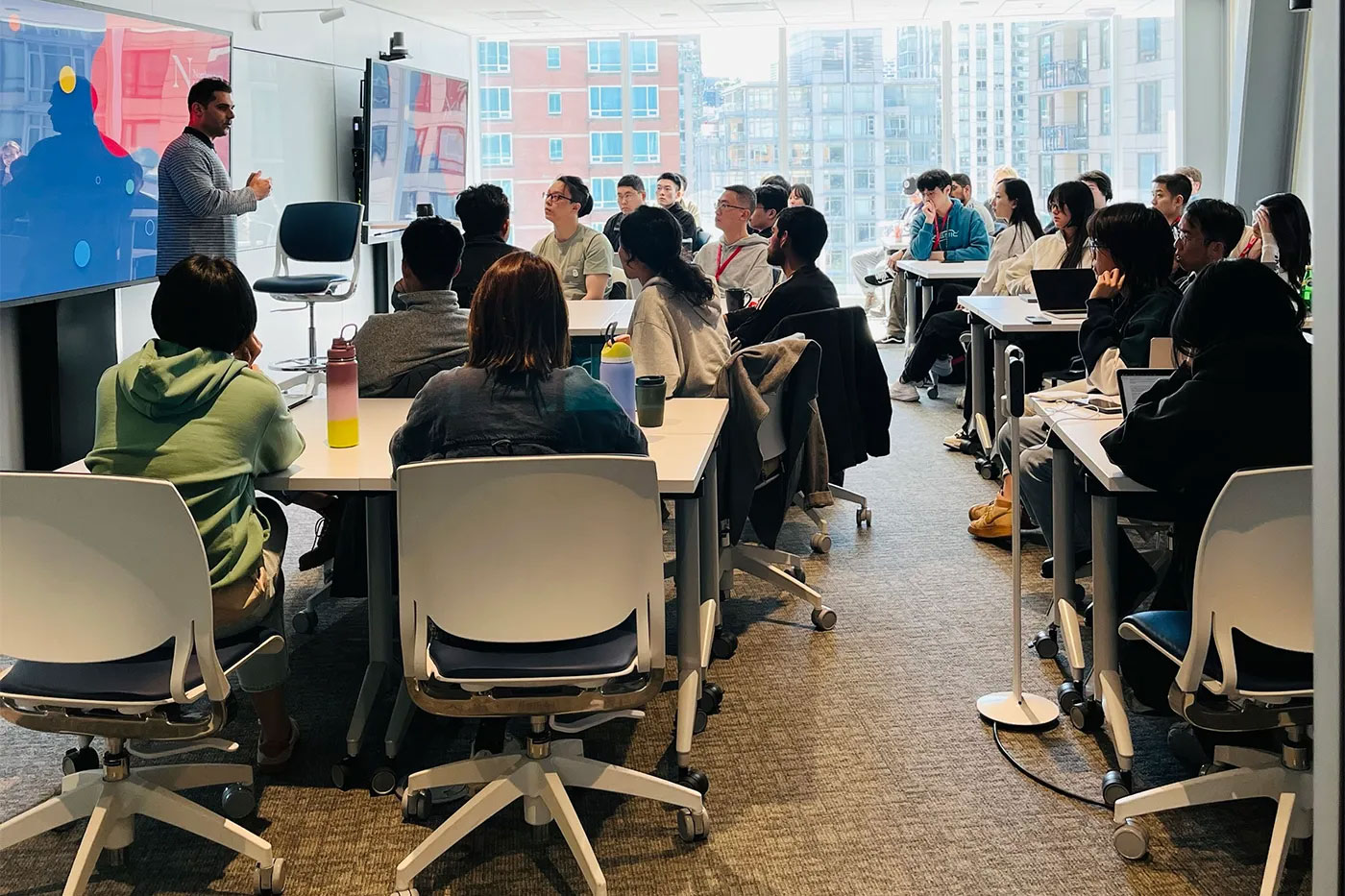
The campus is stepping into this community-building role also by offering space for engagement and collaboration. In a typical week, two or three events of various sizes are hosted on campus and open to Vancouver professionals and students. Some are presented by embedded partners, some by Northeastern faculty, and others by industry partners and affiliates from the wider network.
Regular reading groups for tech topics are led by faculty. Participants review new publications and studies and discuss their impact. Recent discussion groups have centered on cybersecurity, data science, and different areas of artificial intelligence.
And the tech industry occupies a major role in the campus event space. Within that sector, the focus and formats vary widely. In the spring of this year, Cloud Native Vancouver hosted a large networking event as a chapter of the wider Cloud Native Computing Foundation. 021: Zero to One Events hosted workshops for professionals in different fields to upskill with AI tools. Meetups and mixers were hosted by AI engineering group Infer, VanTUG (Vancouver User Technology Group), founder community Novus, and more.
Thanks to a partnership with the Vancouver Tech Journal (VTJ), many major city-wide and provincial events are also held on campus, providing a great interface with government and industry decision-makers. This July, the VTJ and Global Public Affairs are hosting The Year in Vancouver Tech — So Far, a look at the major trends in the industry with founders, investors, and insiders.
An agile program for Canada’s growing tech economy
The program continues to grow and evolve amidst new national opportunities and changing industry conditions.
“We’re going to pay attention not just to technologies but also the ways in which organizations are reshaping and structuring,” Eccles said. “It should always be industry leading the way. I think we’ll soon have more industry research and development opportunities thanks to the massive increase in the government’s R&D investments across Canada. Applied research is a rich area for students who are looking for a great job.”
By working closely with such a large portfolio of partners, the campus is able to keep a read on the pulse of the city’s changing professional scene. Students are able to observe and engage with the latest developments in real time, whether it’s a shift in investment trends, a groundbreaking new discovery, or a change in systems standards.
Beckers sees the embedded partners program as a deeply integrated expression of the university’s experiential learning ethos. The goal is to create a living laboratory where theory and practice intersect daily as students and faculty collaborate with industry on projects, workshops, hackathons, and research initiatives.
“It’s Northeastern’s signature approach scaled and deepened, making industry partnership a foundation to education. Watching students gain confidence through Studio projects with embedded companies like Traction Complete, then seeing them become professionals and continue those relationships, creates a powerful sense of sustainable impact,” says Beckers.
For the foundation that allowed the team to build out a new approach to working with partners, Eccles credits Northeastern’s entrepreneurial and adventurous culture. The university’s consistent press to be on the front foot of education encourages academic teams to propose and build on new ideas. Now that the Vancouver pilot of the embedded partners program has been a success, the model is expanding to other campuses in the near future.
“Innovation is a sincere promise here and not an empty word,” Eccles added. “There may be different evolutions of this program at different campuses. Our value as an institution is truly showcased through our creativity and collaboration, our students and graduates, and through co-ops and our growing portfolio of additional experiential programs. We’re able to provide a real benefit to our local economies and our partners while also giving students a direct path to their professional goals. I’m glad to be working with so many exceptional teams from Vancouver and B.C. as we iterate and expand on this vision.”
Interested in partnering?
Prospective industry partners are invited to reach out to Dominik Beckers for more information. Drop-in tours of the campus are also available during normal business hours.