


From Marketing to Machine Learning: Claire Liu’s Journey into Tech
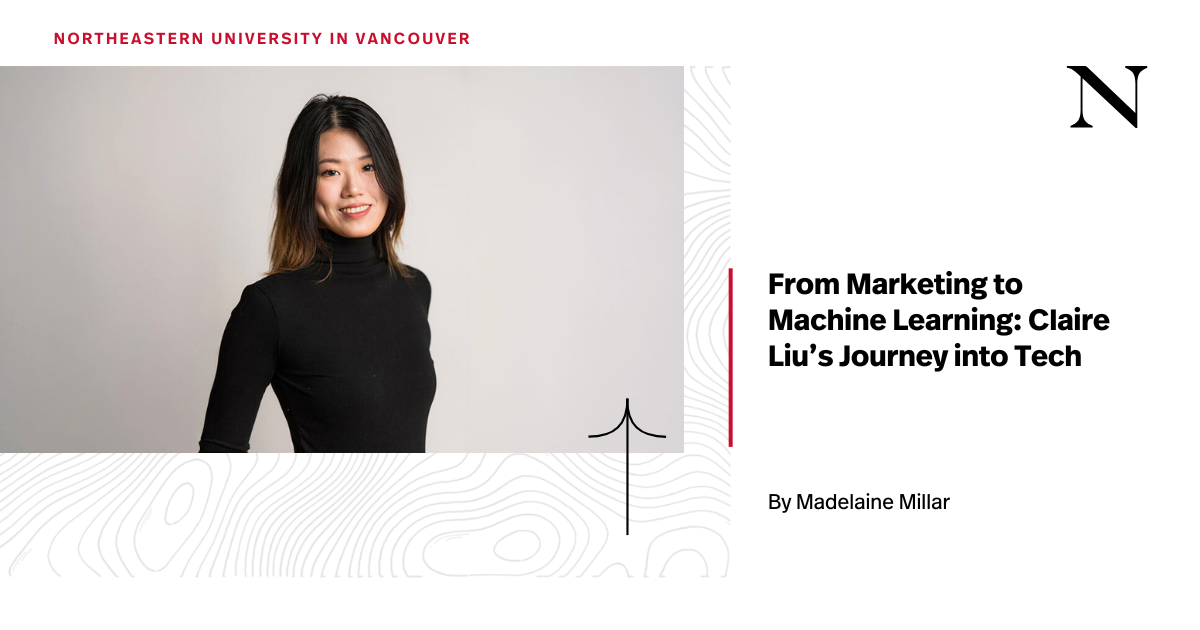
Panxin (Claire) Liu didn’t always want to be a computer scientist. Her bachelor’s degree is in media and advertising, and she was working in marketing in China when artificial intelligence first captured her curiosity.
“When I was still doing marketing in Shanghai, we relied on Open AI to brainstorm some of our ideas, and I was really interested in how it works. People would talk about AI as the future, and I thought ‘I want to know how to do that. I want to learn to code from scratch.’” Liu said. “I feel like in the future, everyone is going to have to know how to code.”
Although she entered her Align MS in computer science with no coding experience, Liu used hackathons, speaker events, and a Khoury Research Apprenticeship to build up her confidence and expertise, ultimately receiving one of Northeastern University’s Outstanding Master’s Student Awards in April of 2025.
Liu joined Northeastern in Vancouver in the spring of 2024 through the Align program, which helps students without a background in computer science break into tech. The initial transition was intense; she wasn’t just learning new skills, but a new way of thinking.
“When you’re learning art or history, you absorb a lot of specific knowledge,” Liu said. “For computer science, though, things change very fast; it’s a continuous learning process. Now, when I see something I’m not familiar with, I won’t be terrified – I just have to read through the documentation.”
To get comfortable in her new field, Liu attended industry speaker sessions and workshops hosted by the college, which she highly recommended to other Align students. She also built-up confidence by participating in hackathons.
Her favourite was in 2024. Sponsored by Telus, the joint Northeastern hackathon at the Vancouver and Toronto campuses challenged students to use past concert data to predict traffic flow during Taylor Swift’s shows in notoriously-congested Toronto. In a day and a half, Liu and her teammates Zheng Gu and Hao Niu used Python, Infogram, and ArcGIS to present detailed traffic predictions, which the Toronto city government could use to manage the movement of half a million Swift fans through the city.
“We analyzed inbound and outbound density, which stations are very crowded, and the peak times,” Liu explained. “I had two teammates who were brilliant at infographics and machine learning, and we wanted to create something very presentable, to give the judges a big-picture idea of our project.”
The team succeeded; their project ‘Swifty Go 1.0’ won the hackathon, and was featured in the Northeastern Global News. It was a confidence boost for Liu, who was starting to find the feeling of learning new tools under a tight deadline more familiar.
“The Align program is like a longer version of a hackathon,” she said, explaining that the first year of the Align program boils the essential material of a typical 4-year CS undergrad into two semesters, to bring its students up to speed with their direct-entry peers. “The whole program takes a very short time – two to three years – but it’s a master’s program, so you’re trying to keep up with students who already have a solid background of four years studying computer science. The program condenses all this content in and gives you the essence.”
At the same time, Liu was curious to see what computer science research had to offer. She was accepted into the Khoury Research Apprenticeship program in the spring of 2025, and when she realized this meant she could work on assistant teaching professor Mirjana Prpa’s project to create an embodied Large Language Model (LLM) agent for supporting English language learning in social VR – the same project she’d been a research subject in the summer before – she jumped on the opportunity.
Live English tutoring can be expensive, difficult to schedule, and uncomfortable for people with social anxiety, but many traditional independent language-learning programs don’t build English skills effectively or keep learners coming back. Prpa’s goal is to figure out whether ELLMA-T – an LLM-based human-looking avatarVRChat – can offer an alternative.
As a research apprentice, Liu has taken on a variety of challenges. The largest has been shifting ELLMA-T from a speech-to-text and text-to-speech process, to real-time audio-to-audio interaction. Doing so has helped to simplify the system’s design and reduce delays caused by text translation, letting ELLMA-T chat more smoothly. She’s more lifelike, like being able to pause when the user interrupts and respond based on their new input, which makes the interaction feel much more conversational.
“I just implemented a feature last week to send the user encouraging messages – we’re targeting introverted people who feel social awkwardness when speaking English, so we want them to feel very supported,” Liu said. “I wanted to implement the agent using the technical skills I’ve learned in class, so I’m really happy that I’m actually making this stuff.”
Working on ELLMA-T has Liu reflecting on whether her career should focus on LLMs, instead of front-end web development like she initially planned. If that’s what she chooses, Prpa thinks she’ll be successful.
“She’s responsible, reliable, and curious to take initiative and explore innovative ways the project can be improved,” Prpa said. “Claire also showed great initiative in learning novel techniques and bringing them to the project.”
Prpa isn’t the only one who’s noticed her apprentice’s talent. Liu recently found out she’s been invited to Boston in April of 2025 to receive one of Northeastern University’s selective Outstanding Network Student Awards for her exceptional work across academics and research in Vancouver.
In the coming semesters, Liu is looking forward to continuing to work on ELLMA-T, participating in hackathons, and honing her coding skills. More than anything, though, she’s excited to see what new interests and opportunities her remaining time at Northeastern in Vancouver has in store.
One of the best things about Northeastern’s Khoury College of Computer Sciences is that it has a very big platform, so students have a lot of resources
“One of the best things about Northeastern’s Khoury College of Computer Sciences is that it has a very big platform, so students have a lot of resources,” Liu said. The one that’s currently piqued her curiosity is Northeastern in Vancouver’s embedded industry space, where partner organizations work directly with students on real-world projects. “I definitely want to get a job after I graduate, and working as a student is totally different from working in the industry. I feel like it’ll be good for me to prepare by working with people who are already professionals.”
By Madelaine Millar