


Northeastern in Vancouver Student Workshop Promotes Gender Equity in STEM
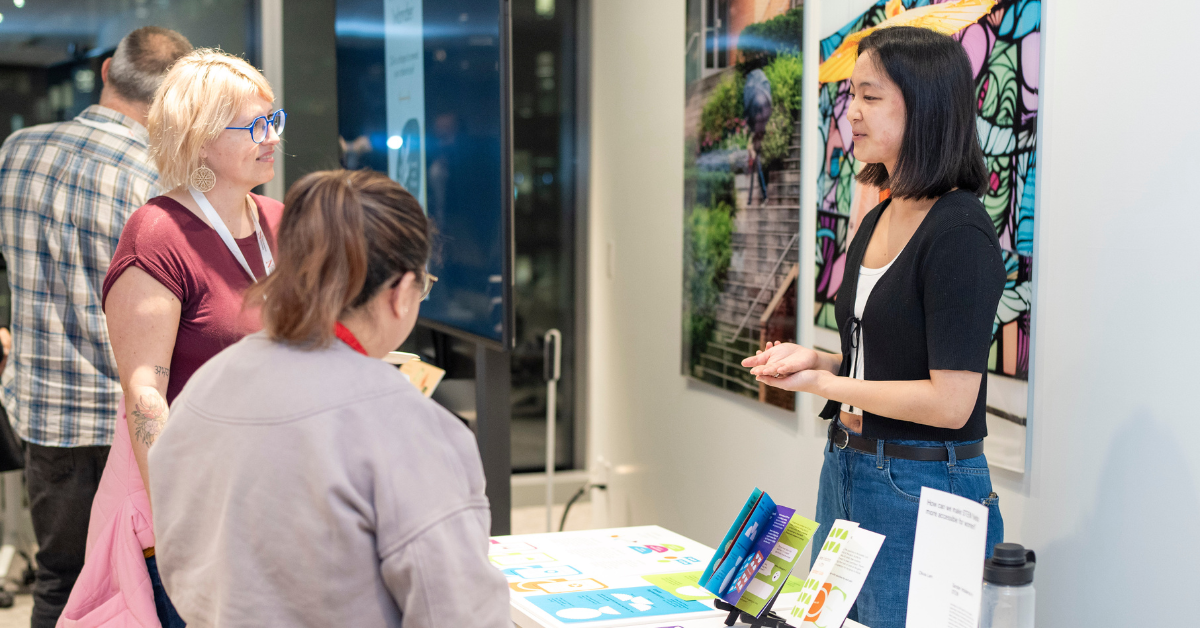
Olivia Lam is a woman who loves research. She knows that isn’t unusual, but in an industry like STEM – where men make up two thirds of the workforce – it can certainly feel that way sometimes. When her Information Visualization Principles and Practices course gave her an opportunity to design a final research project, Lam knew she wanted to find out what’s driving smart, passionate female researchers like herself out of their fields.
Through interviews with a variety of people in STEM, Lam discovered key insights about the feelings of isolation, exclusion, and being misunderstood that women experience in STEM careers, which she’s sharing through a participatory workshop that’s getting people talking about what gender-based discrimination looks like in their own lives.
Gender equity in STEM is a very personal topic for Lam. During her undergraduate studies, she watched with dismay as women dwindled from ranks that had begun solidly co-ed as she reached upper-level computer science courses. She recalled one large, upper-level algorithms course in which she and the five other female students had been delighted to find so many women in the class. They ended up sitting in a corner together, supporting one another but siloed off from the rest of the class.
Now, pursuing a Master of Science in Information Design and Data Visualization at Northeastern University in Vancouver, Lam felt validated to hear her interviewees express familiar, complex feelings about these isolating experiences.
”A lot of the participants mentioned that because there are so few women, and because a lot of the time there are these stereotypical hobbies they may not relate to, that really amplified this feeling of isolation for them in their courses,” Lam said. “Not only do they feel like they don’t relate on a personal level with these people, then they’re almost confined to a corner and not approached at all.”
In addition to feelings of exclusion and isolation, Lam’s interviews identified two other themes: a lack of female representation, and common discriminatory gender stereotypes. Most of her ten interviewees were women working in STEM in Canada – women like Lam, who did her Bachelor’s in Cognitive Systems at UBC. Lam found her interviews with men in STEM illuminating too, though.
”When I asked ‘Why do you think women aren’t in computer science?’ something that I found a little bit surprising was that many men just assumed they weren’t interested.”
”When I asked ‘Why do you think women aren’t in computer science?’ something that I found a little bit surprising was that many men just assumed they weren’t interested,” Lam said. “One person told me ‘guys play video games, and then they get into computers, and that’s why they do computer science.’ Like, girls play video games too! I think there’s a lot of assumptions, that turn into stereotypes, that are affecting their everyday interactions.”
Based on her interviews, Lam designed a workshop that resembles a UX design “probe kit”. Through a paper booklet of reflective exercises, followed by a set of live allyship exercises, Lam’s workshop helps participants reflect on gender-based discrimination in their own lives, and identify how they can make their world more welcoming and inclusive when it does.
“My favourite exercises were the allyship practice exercises. They were hypothetical scenarios of discrimination that you would practice thinking about responses to,” Lam explained. “At the end, they’re all revealed to be actual scenarios that I collected from my user interviews. So, you can’t say this doesn’t happen in real life – these came from real people who experienced it firsthand.”
Lam presented her workshop for the first time at the Northeastern in Vancouver Student Research Showcase at the end of 2024. It was very well received, by both participants and showcase attendees. She found it particularly rewarding when one participant expressed his excitement to use her workshop’s prompts to talk with his young daughter.
“In the field of education, discussions like the one Olivia started are crucial, especially given the impact of industries such as AI. Technology-focused fields, including AI, are often male-dominated, which can lead to programs being designed primarily from a male perspective. This lack of diversity may result in inequalities, as women’s perspectives might be underrepresented. To address this, students should receive training that fosters inclusivity and prepares them to consider diverse viewpoints before entering the industry,” said Jihyun Park, the instructor for the Information Visualization Principles and Practices course in which Olivia conducted her research. “This participatory approach was a great way to shift their perspectives, because it provided a situational and reflective context, allowing participants to explore diverse perspectives in scenarios where gender inequality may arise. People were going ‘Wow, there’s aspects I hadn’t thought about before’.”
Park encouraged Northeastern in Vancouver to build on Lam’s work, and suggested a tech ethics class could help students explore how the methods they use and the tools they create can help or harm marginalized people.
Lam agreed that her workshop can’t be the end of her campus’s conversation about gender equity. She was particularly impressed with the Align program’s inclusive atmosphere – supporting gender equity in computer science was one of former Dean Carla Brodley’s original goals for Align, which saw women participating at almost double the US national average in 2023. Even so, Lam foresees the work of cultivating equity in STEM continuing for a long time to come.
Lam looks forward to seeing what future Northeastern in Vancouver students contribute to that goal. Such research could be supported by Northeastern College of Arts, Media and Design’s Fall 2025 scholarship, which prospective students can learn more about here. Lam also offered some more conceptual advice.
“Ground your research in something that you really care about,” she said. “I really cared about providing a voice for female students that I knew were struggling, based on my experience. I think when you really ground your research in something very tangible to you, it makes a huge difference; it makes people want to speak to you more, because it’s more genuine.”
By Madelaine Millar