Is a Master’s in Health Informatics Worth It in Canada? ROI, Career Outcomes & Market Demand
June 9, 2026

If you’re asking whether a master’s in health informatics is worth the investment, you’re really asking a bigger question: will this degree help you build a stronger, more future-ready career in a changing healthcare system?
For many professionals, the answer is yes.
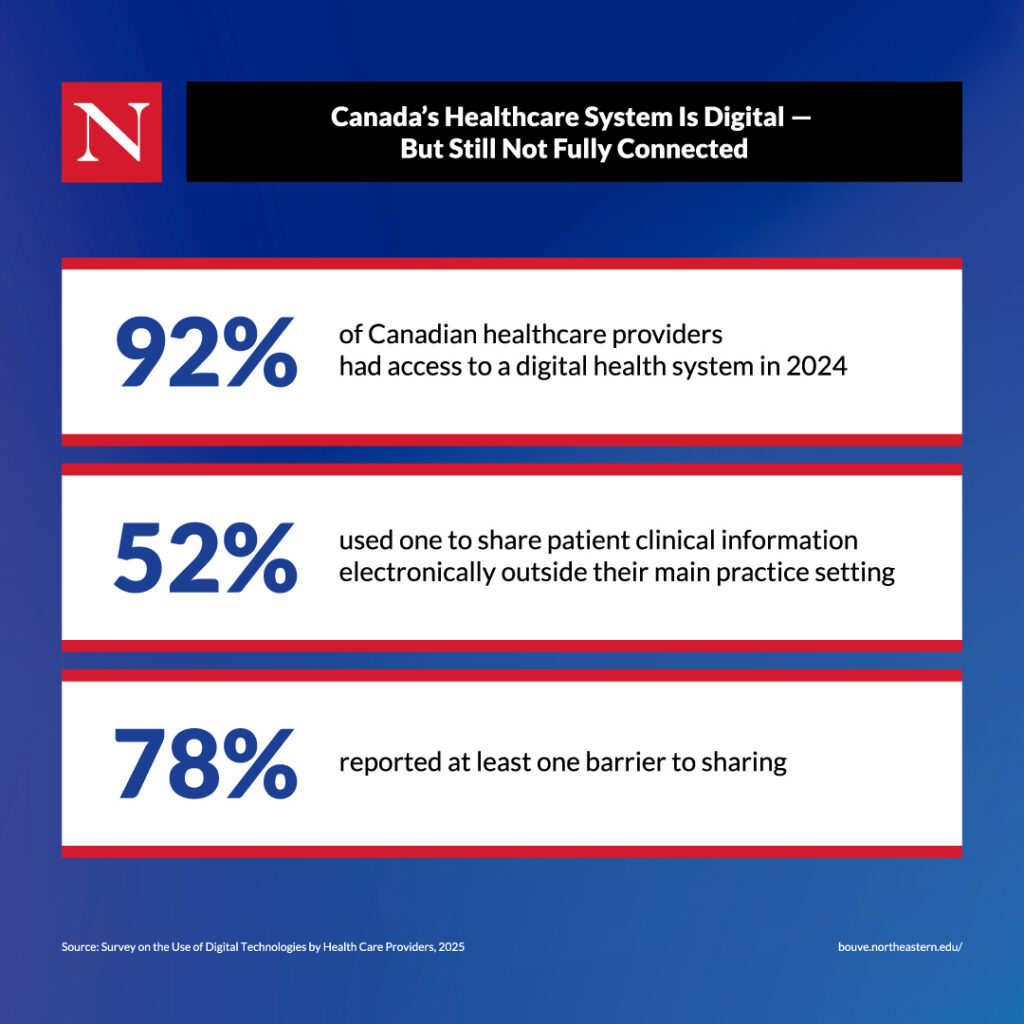
Canada’s healthcare system is becoming more digital, but it is still far from fully connected. In 2024, 92% of Canadian healthcare providers had access to a digital health system, yet only 52% used one to share patient clinical information electronically outside their main practice setting.
At the same time, 78% reported at least one barrier that limited or prevented that kind of information sharing. That gap is part of what makes health informatics such a timely field: healthcare organizations need professionals who can improve how information moves, how systems work, and how data supports care.
As Ryan Rad, Associate Director of the MS in Health Informatics-Vancouver program at Northeastern University, puts it: “Right now there is a massive digital transformation across provincial health systems.”
Key Takeaways
- • Canada’s healthcare system is becoming more digital, but major gaps in interoperability and information sharing remain.
- • A master’s in health informatics can help professionals build stronger skills in healthcare systems, data, analytics, and digital transformation.
- • In Canada, the degree can support career mobility across public health systems, health tech, consulting, research, and policy.
- • For many clinicians, analysts, and IT professionals, the degree can serve as a bridge into more specialized or leadership-oriented roles.
- • Northeastern’s MSHI-Vancouver program offers a Canada-focused, flexible path for students who want to advance in a growing field.

Why Health Informatics Matters More in Canada Right Now
Health informatics sits at the centre of one of the most important shifts in Canadian healthcare: the move toward more connected records, better data use, and more informed decision-making.
CIHI reports that 93% of primary care physicians in Canada were using electronic medical records in 2022, up from 73% in 2015—signifying real progress. But adoption alone is not the same as interoperability.
Patients still struggle to access their own information, and providers still face major hurdles when they need to share it across settings. CIHI also notes that federal, provincial, and territorial governments have made modernizing healthcare information systems and digital tools for secure information sharing one of Canada’s shared health priorities.
That creates an important opportunity for professionals who can do more than understand technology in the abstract. Employers increasingly need people who can connect digital tools to clinical workflows, operational realities, and patient needs.
British Columbia is especially relevant in that conversation. Employment in B.C.’s healthcare sector reached 286,300 in 2021, up by more than 80,000 jobs since 2011. Not every one of those jobs was connected to health informatics directly, but it does show that prospective students are looking at a large and expanding healthcare market in which digital-health expertise is becoming increasingly important.
What Does “Worth It” Really Mean for Prospective Students?
When people think about ROI, salary is usually top of mind. But for a field like health informatics, such thinking is too narrow.
A degree can be worth it because it helps you:
- • Qualify for roles that are harder to access with only general experience
- • Move from technical or clinical work into more strategic positions
- • Build credibility in a field that values both domain knowledge and advanced digital fluency
- • Prepare for leadership, systems, analytics, or innovation-focused work
- • Stay relevant as healthcare becomes more data-driven and AI-aware
Health informatics cannot be limited to just “learning software.” It involves learning how healthcare, information, technology, and people fit together.
Northeastern’s Vancouver-based Master of Science in Health Informatics is an example of how some graduate-level programs keep real-world needs top of mind for their health informatics students. The program—designed specifically for domestic Canadian students—combines health informatics, public health, biostatistics, and business management courses.
It also includes a required capstone project, which gives students the chance to apply what they learn to real-world healthcare challenges.
Career Outcomes: What MS in Health Informatics Graduates Can Expect
A health informatics master’s does not lock you into one narrow job title. That is part of its value.
Depending on your background and goals, the degree can support a variety of roles.
Rad points to three broad opportunity areas in Vancouver and B.C.: public-sector roles with provincial health authorities; private-sector roles with health technology companies and consultancies; and research or policy roles tied to health data, privacy, and decision-making.
That range gives professionals more than one way to use the degree, such as:
- • A nurse or pharmacist moving into systems, strategy, or leadership work
- • A data or IT professional deciding to specialize in healthcare
- • A project manager deepening expertise in digital transformation within a health setting
- • A career changer with relevant experience transitioning into analyst or implementation roles
Where Health Informatics Graduates May Work — And the Salary They Might Expect
In Canada, and especially in British Columbia, graduates may find opportunities across public health systems, hospitals and clinics, health technology companies, consulting firms, and research or policy organizations.
In British Columbia, the median hourly wage for a health information management practitioner—one of the many job titles open to graduates—is $30.60 per hour, with wages ranging from $25.61 to $53.00 depending on the role and region. In the Lower Mainland–Southwest region, which includes Vancouver, the median is also $30.60 per hour, and the upper end reaches $60.20 per hour.
More broadly, WorkBC currently lists Health Information Management Occupations as a high opportunity occupation, with 350 projected openings from 2025 to 2035.
While such occupations do not represent a one-to-one map of every master’s-level informatics pathway, it does show that related health information work remains in demand across the province.

Why a Master’s is Becoming More Valuable in This Field
It is still possible to find related roles in health information or digital-health operations without a master’s degree. But increasingly employers are looking for someone with advanced educational credentials.
A master’s often adds depth to a professional’s skill set, such as:
- • Stronger understanding of healthcare systems and workflows
- • More advanced data and analytics knowledge
- • Greater fluency in health information systems
- • More confidence working across clinical, technical, and business stakeholders
- • Preparation for more specialized or leadership-oriented roles
As the field becomes more sophisticated, advanced study can make it easier to stand out and move upward. As Rad put it, “the master degree is becoming increasingly the standard in this space.”
That is especially true in areas shaped by AI, predictive modeling, health data ethics, and system-level improvement. Healthcare has, according to Rad, been more cautious than other industries when it comes to new technology, but it is still changing rapidly and professionals who can embrace the promise while still understanding the limitations of AI in healthcare settings are likely to be increasingly valuable in the years ahead.

What Makes Northeastern’s Program Stand Out?
Not every graduate program is built for the same audience or the same market. One reason Northeastern’s MSHI-Vancouver program stands out is that it is designed specifically for domestic Canadian students and the Canadian healthcare context.
That’s important given that health informatics—the responsibilities and requirements—is shaped by the systems where graduates actually want to work.
Northeastern’s program is interdisciplinary in structure—a joint venture between Bouvé College of Health Sciences and the Khoury College of Computer Sciences—includes a flexible format, and a focus on bridging the gap between clinical care and modern health technology practices.
The curriculum is intended for both healthcare professionals with limited computing experience and IT professionals with limited healthcare experience, which makes it especially relevant for people trying to build the “bridge” skill set employers often need.
Offered online, the program can be completed part time or full time (typically 18-24 months), which allows some students to continue working while enrolled. That can be a game-changer for many professionals, as the cost of graduate education is not just tuition (CA $41,019) but also time, opportunity cost, and the chance to keep building experience while enrolled.
Is a Master’s in Health Informatics Worth It for Canadian Students?
For many people, yes.
An MS in Health Informatics can help you:
- • Move into a more specialized digital-health role
- • Pair healthcare experience with stronger technical and analytics skills
- • Pair technical experience with deeper healthcare knowledge
- • Build toward leadership, systems, research, or innovation work
- • Position yourself in a field that is becoming more important as Canadian healthcare modernizes
A degree will not guarantee any one title or salary. But if your goal is to build a career around improving healthcare through data, systems, and technology, a master’s in health informatics can offer a meaningful return.
If you want to explore whether Northeastern’s Vancouver MSHI aligns with your goals, visit Master of Science in Health Informatics – Vancouver.