Students at Northeastern University’s Vancouver Campus Step Into Health Tech
June 24, 2025
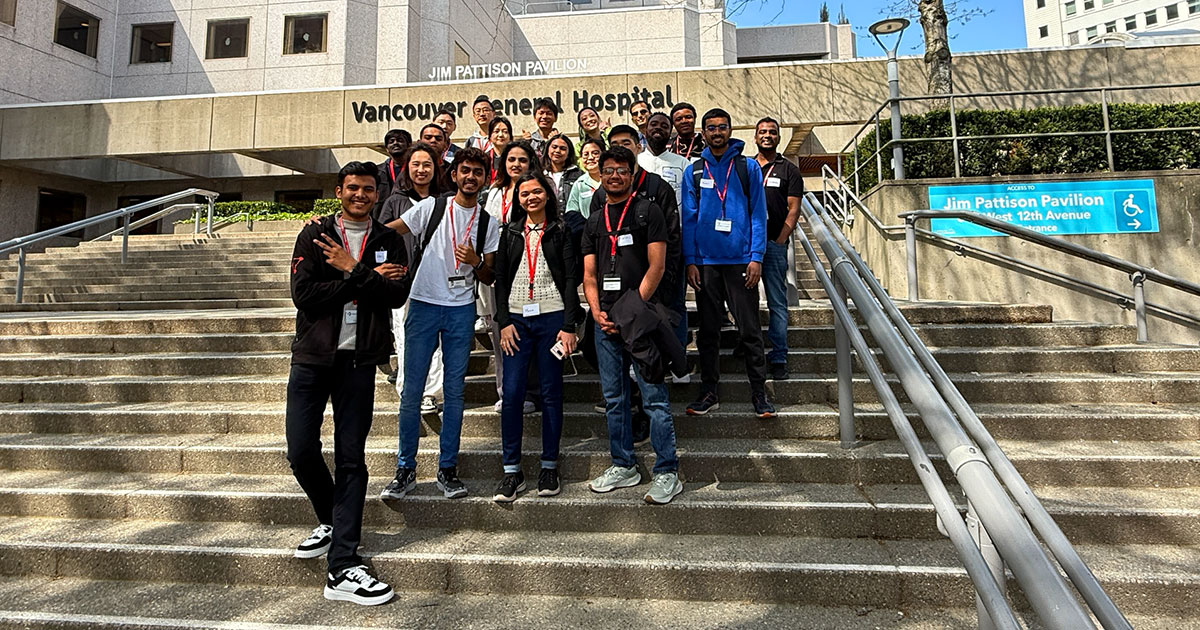
Stepping into a hyperbaric chamber, inspecting surgical robots up close, and walking hospital hallways in scrubs are typically reserved for healthcare professionals and patients.
But for twenty Northeastern Vancouver graduate students on a tour of Vancouver General Hospital (VGH) last April 30, it was a hands-on learning experience.
Part of an experiential learning initiative organized by the College of Engineering (CoE) in partnership with Lower Mainland Biomedical Engineering (LMBME), the tour immersed students from programs like Information Systems and Data Analytics Engineering in the fast-evolving world of healthcare technology.
The initiative was a follow-up event to a CoE Co-op Speaker Series by Alice Casagrande Cesconetto, Regional Engineering Team Leader at LMBME. Her presentation explored the future of health tech careers, laying the groundwork for this on-site visit that brought concepts to life.
A front-row look at health tech
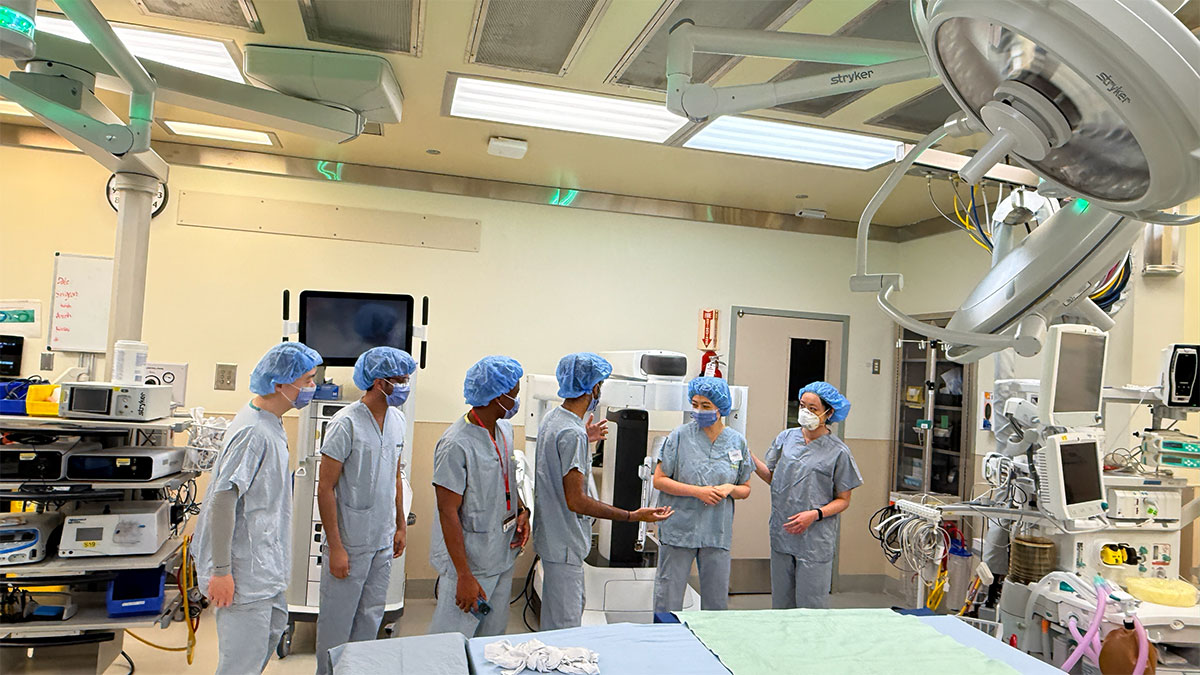
Students visited operating rooms, an intensive care unit (ICU), and British Columbia’s only hyperbaric oxygen treatment centre. Touring these areas and interacting with devices like infusion pumps, ventilators, and the da Vinci Surgical System gave them firsthand insight into how clinical tools are developed, maintained, and deployed.
Dan Driedger, senior biomedical technologist at VGH, led the hyperbaric chamber segment, offering both technical details and personal anecdotes about the device he helped design. “Dan was so enthusiastic. He was part of the project from the start, so he knew every detail,” said Dhaval Jariwala, a recent graduate.
The surgical robotics suite, equipped with da Vinci systems, also impressed students. “When we saw it, we were like, ‘We need a picture next to the god,’” joked Anirudh Murale, a Master’s in Information Systems student.
Beyond the gadgets, students learned about the invisible heroes behind them: biomedical engineers and technologists. “Biomedical engineers and technologists are hospitals’ unsung heroes,” said Brian Hyun Woo Lee, LMBME Education Coordinator. “We help doctors and nurses do their jobs and provide the best patient care.”
Making personal connections
For Information Systems student Mara Pacres, the tour offered a peek into a world she hadn’t considered. “You can save lives without being on the front lines,” she said, reflecting on how healthcare technology roles are both essential and rewarding.
You can save lives without being on the front lines
Murale, whose family history includes a doctor and a pharmaceutical entrepreneur, was quick to sign up for the visit. His interest lies in integrating patient monitoring systems with medical databases. “Data integration can help doctors save time,” he said.
Jariwala, a recent Data Analytics Engineering graduate, connected the hospital tour to his co-op at TransLink, where he worked with sensor data. Seeing parallels between transit analytics and operating room vitals collection sparked ideas about how data science could improve clinical outcomes.
Charting new career pathways
The tour left a lasting impression. Murale began researching healthcare-focused co-ops and electives. Others saw opportunities in health informatics — a burgeoning field combining data, IT, and patient care.
While regulated roles like clinical engineer require specific certifications, students learned about unregulated roles in healthcare technology management and data analytics. “Peripheral skill sets can really enhance what we do,” said Driedger. “There are lots of opportunities for equipment planners, project managers, and project coordinators,” Lee added.
Northeastern Vancouver will launch a Master of Science in Health Informatics in fall 2025, offering students a formal pathway into these tech-forward healthcare roles.

Why experiential learning matters
Experiential learning goes beyond skill-building. It gives students exposure to unfamiliar environments and ideas — a shift that can reshape how they view their field.
“As software engineers, we tend to live in a bubble. This experience showed us what’s actually required in the real world,” Jariwala said, highlighting the continued relevance of core engineering amid AI hype.
“Exposure to different sectors and systems can inspire fresh ways of thinking and problem-solving,” said Siyi Cheng, College of Engineering Co-op Education faculty member and lead organizer. “Curiosity, humility, and cross-disciplinary understanding are career superpowers.”
By Marcelle da Costa Santos