Students bring AI and robotics together at Northeastern Vancouver
October 6, 2026
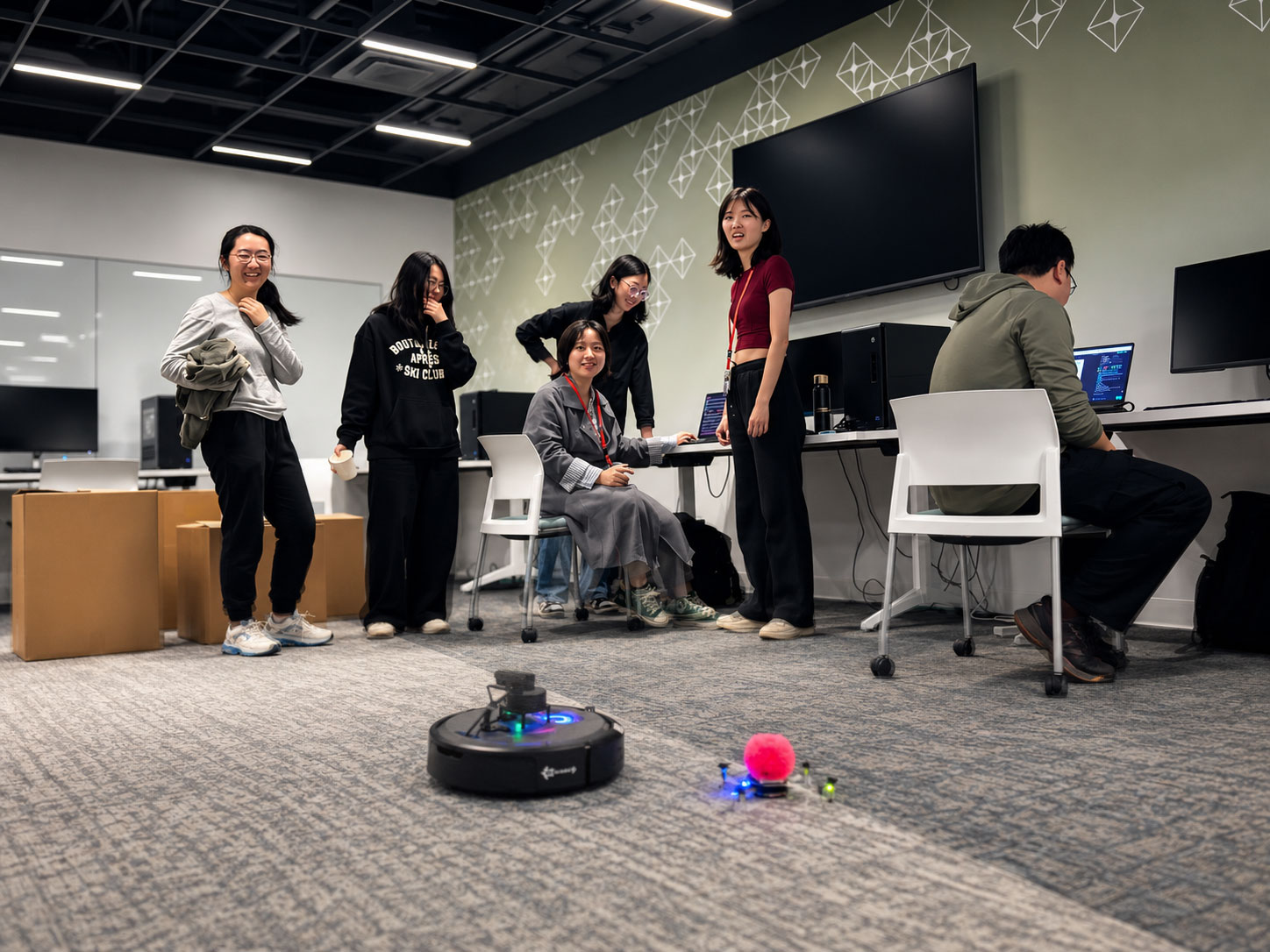
Throughout the latter half of the 20th century, science fiction authors dreamed about a robot that could understand and execute complex instructions spoken in plain, conversational language. But the reality has historically been tough to achieve: robots need precise commands to initiate specific actions, and human speech is notoriously inexact.
Can large language models, capable of processing natural human speech into robot-friendly command language, change that?
That integration of robotics and AI is the problem that second-year Master of Science in Computer Science (MSCS) student Tong Wu and his groupmates, Xuetao Li, En-Ping Su, Dayu Wang, and Jingsi Zhang, decided to tackle in the spring of 2026. Their goal was to build an AI-enabled robot that could physically guide a user around a classroom prompted only by plain-language vocal commands.
Professor and Assistant Director of Computing Programs Jack Thomas, who taught the course Robotic Science and Systems (CS 5335), loved the idea. It had first been suggested by MSCS student Kalhar Pandya, who imagined the campus agent while working as a Teaching Assistant for Northeastern in Vancouver’s very first robotics course in the fall of 2025. But Pandya was away on a co-op with Oracle that he’d landed through the Vancouver campus’s Embedded Partnership Program, so Thomas was pleased to see Wu and his teammates pick the project up the next semester.
But executing real-life robotics is complicated.
Robotics is made up of a hundred related fields’ problems, and you are trying to get all of them to play nice.
“I tell students, wait until you get in the lab. You’ll realize there’s a shaky house of cards holding up every robot, and adding even one more card onto the stack is not easy,” Thomas said, explaining that theoretical environments often don’t necessitate the same creative problem-solving that physical robotics demands. “Robotics is made up of a hundred related fields’ problems, and you are trying to get all of them to play nice.”
Like Thomas predicted, the problems Wu and his team solved weren’t the ones they expected to.
“There were a lot of hardware configuration issues, and we got tired of re-configuring it every time. So, we basically built a configuration platform within our project,” Wu said. They made the platform open source, so other robotics students could use it too; “One reason many of our spring teams could only make simulation environments work was because they didn’t have time to configure the robot. We thought this platform could be quite beneficial for future students.”
That perseverance and flexible problem-solving are exactly the skills that Thomas hopes his students will take away from his class.
“Robotics is really hard to do, even basic stuff,” Thomas said. “Trying to make the real thing happen – even though it’s hard and there’s a lot of weird dead ends – is worth the extra effort. That’s useful to them professionally.”
Wu and his teammates shared their work in simulation at Northeastern in Vancouver’s Student Research Showcase, where they received feedback from Vancouver robotics industry professionals. Other impressive robotics projects included a robot programmed to solve a maze, and a pair of cat-and-mouse robots – complete with fuzzy ears – that used optical data to chase one another around the room. Attendees who saw the robots in action were curious to learn more, and a number of students approached Thomas to ask about enrolling in his course.
“We were able to communicate and showcase our capability well, so that was quite exciting,” Wu said. “We were talking to new people about our project, and able to practice robotics at the same time.”
Northeastern in Vancouver’s robotics environment is a very collaborative community. There is perhaps no better evidence than the fact that Pandya, upon returning from his co-op, decided his capstone should pick up where Wu and his teammates left off. Along with fellow Northeastern in Vancouver and Oakland students Sibgha Ahmad, Shibo Bai, and Fazheng Han, he’s spending the summer of 2026 working on a full white paper of the campus agent system.
“Robotics at Northeastern in Vancouver opens exploration in a way that is much more self-directed. It gives you ownership of the things you do,” Pandya said, describing the showcase project as a great demonstration. “Jack never restricts students – all of the projects are open-ended.”
Thomas is thrilled with Wu and his team’s work, and with Pandya’s continuing progress on his capstone, but he also wants to further expand future students’ opportunities to work with industry. He’s in talks with three Vancouver robotics companies about becoming industry partners, and has begun bringing students to the BC Robotics Collective. He’s also co-founding the inter-campus collaboration NU Northwest Robotics, to ensure Vancouver and Seattle students have access to robotics opportunities on both campuses.
“Robotics is growing in Vancouver in general,” said Wu, who attended the BC Robotics Collective with Thomas in the spring of 2026. “Software development seems to be becoming too competitive, so having robotics exposure could be beneficial for students to differentiate themselves…I would definitely recommend people take the Robotic Science and Systems course.”