Healthcare innovation in Canada and the USA enabled by Align Computer Science program
May 7, 2026
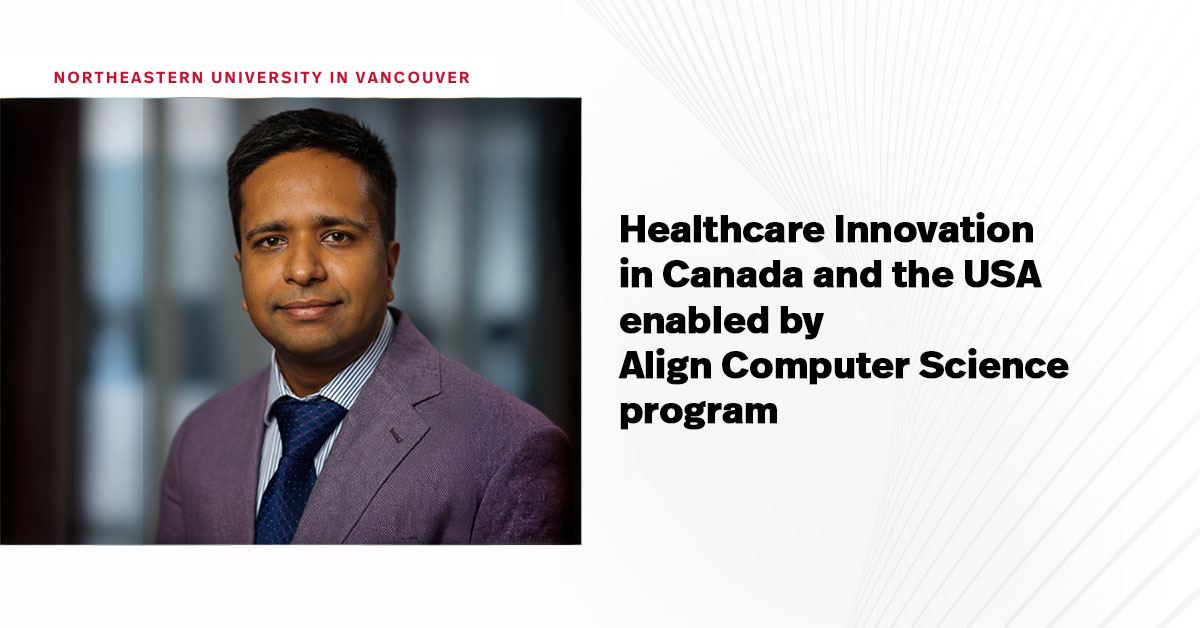
An academic pivot can often lead to a shared passion for two disciplines and a way to integrate them into a career. For Align master of science in computer science alum Monideep Chakraborti, the medical school interview process helped him realize that he wanted a different path, one that led him to his interdisciplinary work in biomedical and computer sciences.
Before joining Northeastern, Chakraborti had completed a bachelor’s in biochemistry and molecular biology at Boston University and a master’s in biomedical sciences at Rutgers University. He credits that scientific foundation with shaping how he approached the pivot to computer science.
“With pre-med, I was always more fixated with biology, and I never realized I could also be a computer scientist,” Chakraborti said. “The trigger point was an introductory computer science course. I heard Northeastern was starting up in Vancouver, so I decided to give it a shot and became part of the first Align cohort.”
Although Northeastern offered him the option to study in Boston, Chakraborti chose the Vancouver campus to be close to family.
Northeastern Vancouver’s experiential learning model proved to be a natural fit for Chakraborti. Background readings before class, in-depth group discussions, and assignments that flowed directly from those conversations helped him apply concepts in real time rather than in isolation.
“I was going into lectures well prepared with the material,” Chakraborti explained. “I already had a baseline, and the breakout group discussions and projects helped me solidify my understanding and apply it to the assignments.”
The opportunity to learn from professors and peers with a variety of academic backgrounds was a highlight of the Align program for Chakraborti.
Now I’m equally comfortable with both technical and product work, and I can connect my biomedical science background directly with the computer science skills I built at Northeastern.
“Being in that environment helped me push through the imposter syndrome that comes with switching fields,” he said. “Now I’m equally comfortable with both technical and product work, and I can connect my biomedical science background directly with the computer science skills I built at Northeastern.”
Chakraborti got an opportunity to integrate his two disciplines as a machine learning research assistant, working with professor Aanchan Mohan on improving speech recognition accuracy for atypical speakers. He presented the research at the Responsible AI Symposium in Vancouver, taking first place for his poster presentation.
After graduating, Chakraborti joined Happy Prime, a Vancouver-based startup founded by Mohan that builds software to enable fluid communication for people with atypical speech. As a product manager at Happy Prime, he honed his product instincts before moving to a job with the US federal government.
Chakraborti currently works as an AI product manager at the National Library of Medicine (NLM), supporting the National Center for Biotechnology Information (NCBI), part of the National Institutes of Health (NIH) in Bethesda, Maryland. He joined through the U.S. Digital Corps, a two-year fellowship that places technologists within federal agencies to work on high-impact projects in areas like AI, public health, and cybersecurity.
“I knew I wanted to get back to the East Coast,” he said. “I was selected by NIH because of the overlap of my biomedical and computer sciences experiences. My job bridges product strategy and technical execution to modernize the search infrastructure used by over six million scientists every day.”
Having participated in the AI field since 2022, Chakraborti has seen firsthand the impact of generative AI in everyday life. Long term, he wants to use his interdisciplinary background to improve and streamline healthcare systems across the United States, from drug discovery to delivery.
“What I love about the Align program in the age of generative AI is that people coming from different backgrounds have a real advantage,” he said. “I have friends who came in from accounting, public health, literature – and that perspective matters. AI can handle coding and pattern recognition, but decision-making is uniquely human. It relies on taste and judgment. Whatever background you have, even if it doesn’t feel relevant, it gives you an edge down the line.”
By Benjamin Hosking