Clinical Informatics Specialist: Day-to-Day Work & Career Path
July 15, 2026
Information that’s poorly managed and too dense to interpret doesn’t offer much value as a resource. Data and technology can help answer many of Canada’s healthcare challenges, but the industry needs the help of clinical informatics specialists who can make information systems better at coordinating, sharing, and analysing health data.
Health informatics is a growing field that uses data, technology, systems thinking, and healthcare knowledge to improve clinical workflows, healthcare operations, and decision-making. If you’re curious about this career path, the role of a clinical informatics specialist offers a clear example of the day-to-day work you can expect when entering the field.
That work is especially relevant in Canada, where healthcare organizations have made major progress adopting electronic medical records but still face challenges related to access, sharing, and interoperability. CIHI reports that 93% of primary care physicians used electronic medical records in 2022, but health information can still be difficult for patients to access and for providers to share.
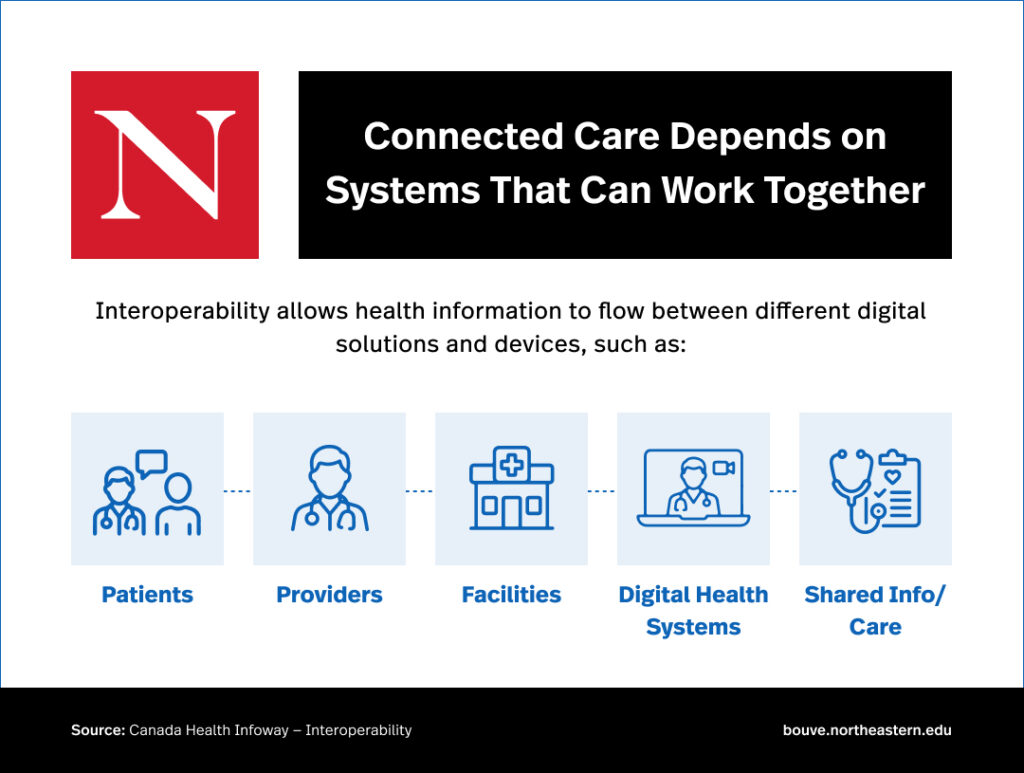
Canada Health Infoway describes interoperability across the health system as the ability for information to flow between different digital solutions and devices so different parts of the health system can “speak the same language.”
A career in clinical informatics gives you in-demand skills that are beneficial for long-term growth, especially if you want to advance to leadership roles. Here, we provide a breakdown of a typical clinical informatics specialist job description, how the role compares to analyst-oriented work, and the most important skills needed for the role.
Key Takeaways
- • Clinical informatics specialists help healthcare organizations connect clinical needs with digital systems, data, workflows, and decision-making.
- • The role often involves supporting implementation, workflow improvement, training, reporting, stakeholder communication, and system adoption.
- • Clinical informatics specialists and analysts may work closely together, but specialist roles often place more emphasis on helping teams use systems effectively.
- • In Canada, the role is increasingly relevant as healthcare organizations modernize electronic health records, improve interoperability, and explore responsible uses of AI.
- • Northeastern’s MS in Health Informatics – Vancouver helps students build cross-functional skills across healthcare, data, technology, public health, and business.
What a Clinical Informatics Specialist Actually Does
A clinical informatics specialist helps healthcare providers use information systems to track, manage, and interpret health data. Working in environments such as clinics, hospitals, pharmacies, health authorities, health technology companies, consulting environments, and insurance companies, specialists help improve processes that protect data, share insight with stakeholders, and streamline operations.
Connects Clinical Needs to Digital Tools and Data
Healthcare organizations depend on a constant exchange of information to deliver quality care. Providers have to manage patient records, appointment schedules, public health risk factors, pharmaceutical research, and countless other types of data.
By looking at the clinical outcomes an organization wants to achieve, specialists can help shape digital workflows, system requirements, documentation practices, and training plans. At times, this could involve working with IT teams to configure systems, improve templates, support reporting needs, or refine how information is captured and shared.
Specialists might also support the use of new technology such as AI-powered data analytics and predictive modelling, especially when those tools are being evaluated for diagnostics, decision support, or operational improvement.
Supports Implementation, Workflow Improvement, and Decision Support
To “manage” information, specialists have to think about how data is used, who needs to access it, and how to deliver it safely. Not to mention, organizations have to comply with regulatory standards and respect patient privacy.
Keeping all of these factors in mind, clinical informatics specialists may help plan the protocols staff must follow to safely document, access, and share data. This can include supporting cybersecurity best practices, working with IT teams to identify system issues, and helping troubleshoot information systems when problems arise.
Another important aspect of the role is helping organizations use analytics tools to identify data trends. Specialists support administrators and clinicians by using technology to understand how organizations can improve efficiency, reduce bottlenecks, or provide better patient care.
Works Across Teams Rather Than in Isolation
Health informatics is a cross-functional field, which is why it’s essential for specialists to understand clinical and technical operations. Specialists have to think like an administrator and have the ability to manage resources, resolve bottlenecks, and help determine which systems or workflow changes may produce the best results.
Not every day is spent inside a database or EHR platform. Much of the work involves listening to clinicians, documenting pain points, coordinating with IT teams, and helping people understand why a system change matters.
Clinical Informatics Specialist vs. Clinical Informatics Analyst: What’s the Difference?
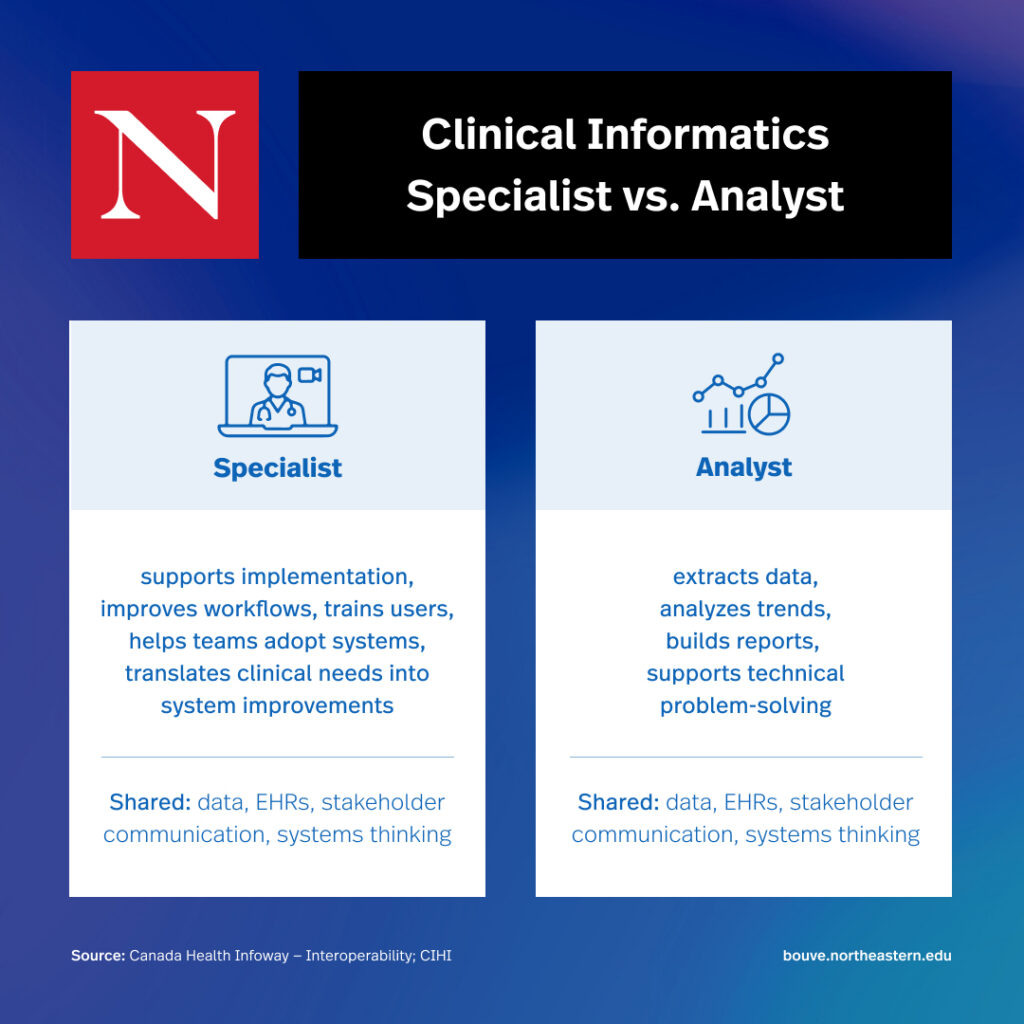
Clinical informatics specialists and clinical informatics analysts may work on similar teams, and the titles can overlap depending on the employer. However, the focus of each role is often slightly different.
A clinical informatics analyst may spend more time extracting, processing, interpreting, and reporting on data. Analyst roles often emphasize data analysis, system evaluation, reporting, and technical problem-solving.
A clinical informatics specialist often focuses more on implementation, adoption, training, workflow improvement, and translating clinical needs into practical technology changes. Specialists help close the gap between what a system can do and how clinicians, administrators, and patients actually experience it.
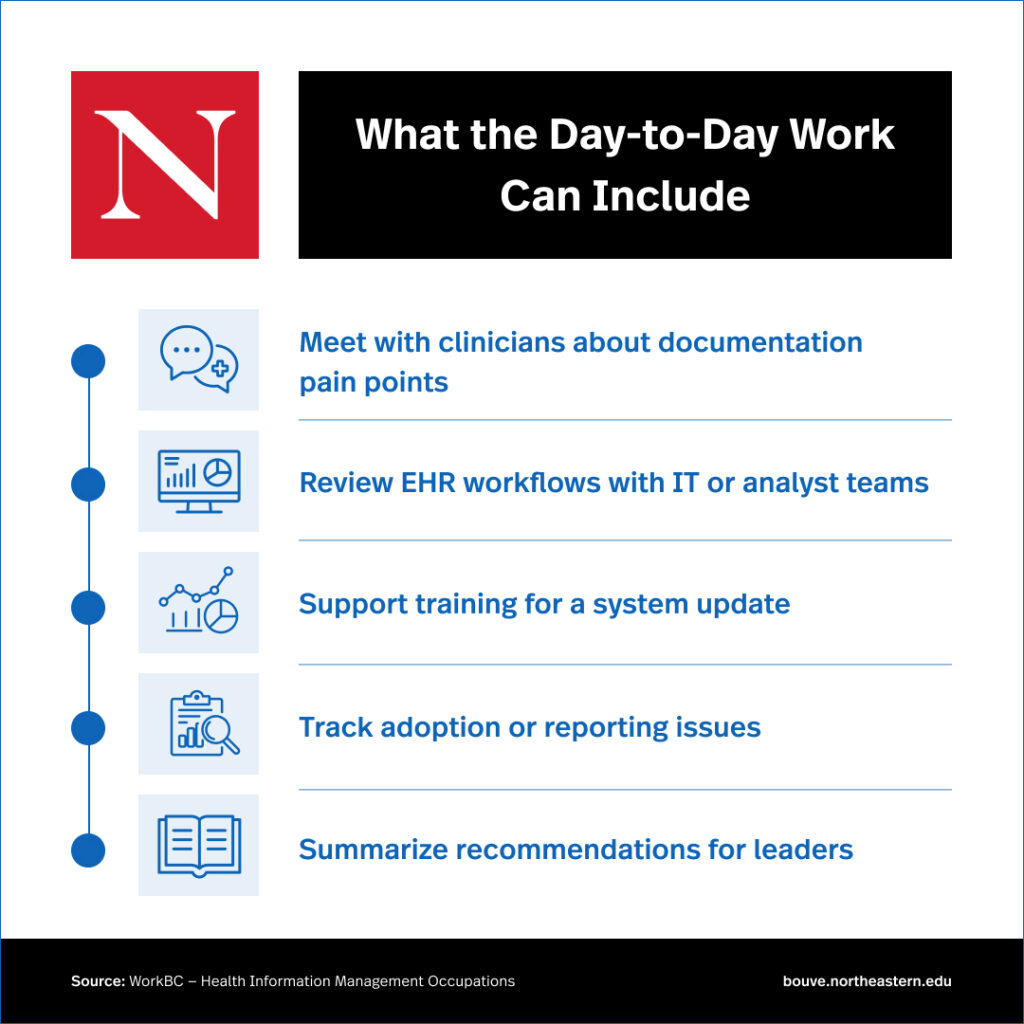
What the Day-to-Day Work Can Include
Depending on the type of healthcare organization, a typical day in the life of a clinical informatics specialist could involve:
- • Meeting with stakeholders: Informatics specialists educate clinicians, administrative staff, and other IT technicians on the correct use of information systems.
- • Reviewing workflows and system issues: Maintaining the integrity and security of IT systems is an ongoing role. Specialists have to make sure data is up-to-date and consistent across different touchpoints so that all stakeholders can make informed decisions.
- • Using data/reporting to guide improvement: Specialists may support databases, dashboards, reports, and analytics tools that evaluate data in different ways. By finding and monitoring patterns in patient outcomes, resources, staffing, and workflows, specialists can develop reports to identify areas of improvement.
- • Translating technical findings for nontechnical audiences: Many stakeholders involved in healthcare are not technical experts. Informatics specialists simplify data reporting to make complex information more accessible.
- • Supporting training and adoption: Specialists may prepare training materials, answer user questions, and help clinical or administrative teams adjust to workflow changes after a new system, tool, or process is introduced.
For example, a clinical informatics specialist might spend part of the day meeting with nurses about documentation pain points, reviewing EHR workflows with an IT analyst, preparing training materials for a system update, and summarizing adoption or reporting issues for operational leaders. Understanding the data is only one part of the job. Specialists also have to help clinical teams use digital tools in ways that support safer, more efficient care.
Skills and Tools That Matter Most
Clinical informatics specialists need clinical competence and a refined technical skill set to succeed in this field, such as:
- • EHR familiarity: Electronic health records contain vital data about patient medical history and interactions with providers. As Canadian health systems continue working toward more connected electronic health information, specialists need to understand how EHRs support documentation, reporting, and care coordination.
- • SQL/Python foundations: Learning core programming languages like SQL and Python can help professionals understand how data is stored, extracted, processed, and prepared for analysis.
- • Visualisation tools: Diagrams, dashboards, and data models are important tools for explaining technical information to stakeholders.
- • Communication and systems thinking: To create solutions, informatics specialists need to understand how different roles in healthcare are connected and depend on shared data for efficiency.
- • Change management and training: Specialists often help clinical and administrative teams adopt new systems, understand workflow changes, and use digital tools consistently.
A Common Career Path into the Role
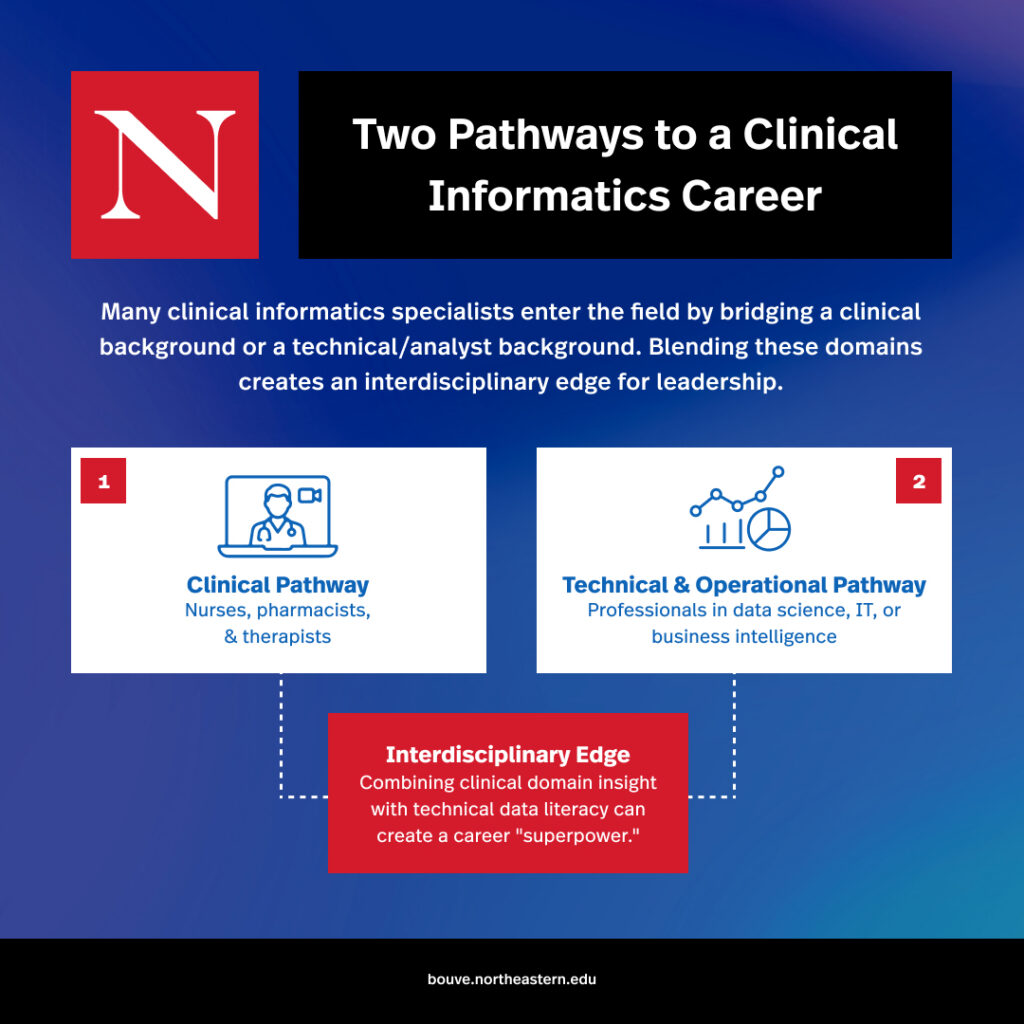
Clinical informatics specialists enter the field through two common career paths: a clinical role or an analyst role. Clinicians like nurses, pharmacists, and therapists earn a degree in a health field and experience how healthcare systems function from a provider perspective.
Analysts come from a variety of backgrounds like data science, business intelligence, cybersecurity, or supply chain management. By studying the operating conditions of their respective industries, such as cost, efficiency, and risk, analysts learn to manage projects and use data for decision making.
Many clinicians and analysts pursue graduate education as a bridge to leadership, specialization, or more cross-functional informatics roles. In a health informatics degree program, professionals look closely at healthcare processes, patient populations, and information management.
Using data analytics, specialists develop ways to streamline workflows, design better information systems, and improve care outcomes while factoring in important issues like patient privacy, technology, and compliance.
Clinical Informatics Specialist Role Well Positioned for the Future
A strategic move into the health informatics field can offer lasting career benefits. As the healthcare sector introduces more advanced tools like AI, employers will depend on experienced informatics specialists to explore the technology’s capabilities and limitations. The public health and ethical concerns inherent in healthcare make it vital for professionals to test tools thoroughly and make sure healthcare technology is used responsibly.
Canada has made significant progress adopting electronic medical records, but many systems still face challenges with access, sharing, and interoperability. That means healthcare organizations may have increased access to health data, but still need a specialized workforce that can help collect, interpret, share, and apply that data with precision. Having interdisciplinary domain expertise in areas like project management, patient engagement informatics, workflow design, and healthcare interface design can differentiate candidates when pursuing advanced roles.
The Northeastern Advantage
Overseeing information systems already requires a strong technical foundation, but working within the health sector involves a deeper familiarity with operations management, ethics, privacy, and security. Starting off your career with a comprehensive education can help you develop a cross-functional skill set that aids in long-term job flexibility.
The Master of Science in Health Informatics – Vancouver at Northeastern University is designed to prepare professionals to bridge the gap between clinical care and modern health technology practices. The program’s interdisciplinary curriculum combines health informatics, public health, biostatistics, and business management, with a focus on improving care through data and technology.
The program also includes a required capstone project that allows students to apply their skills to real-world challenges in Canadian healthcare. That applied experience matters for students who want to move beyond theory and understand how informatics work shows up in real healthcare settings.
Northeastern’s program is also designed for students with different backgrounds—serving students with no clinical or technical experience, as well as those who already have experience in either discipline. For career changers, that can be especially important because informatics often requires professionals to build fluency in both healthcare and technology.
Ryan Rad, Associate Director of the MS in Health Informatics-Vancouver program, sees that combination as one of the major advantages of the field. “If you have a background in health informatics, or in the healthcare industry in general, that is actually your superpower,” he says, “because you understand AI and you understand the new technology. That combination is going to put you in a position that no one with only a computer science degree can be in.”
Northeastern’s program also seeks to prepare students to address the combined clinical, technical, and business needs of health-related professionals. For students interested in clinical informatics specialist roles, that mix of technical, clinical, and business preparation is especially relevant.
Is a Clinical Informatics Specialist Career Right for You?
Clinical informatics specialists help make digital health systems work better for the people who rely on them. They connect clinical needs with technical solutions, support workflow improvement, help teams adopt new tools, and translate complex information into practical guidance.
That combination of skills is increasingly valuable as Canadian healthcare organizations continue to modernize electronic health records, improve interoperability, and explore responsible uses of AI and analytics. For professionals with a clinical, technical, or operational background, the specialist path can offer a way to build more cross-functional expertise and move toward leadership-oriented informatics roles.
The broadness of the healthcare sector also means there are many environments and subdisciplines you can pursue after gaining more experience. If you are drawn to the complexity of analytics and the leadership aspect of helping others adopt technology, clinical informatics may be a strong fit.
Northeastern University’s MS in Health Informatics – Vancouver is designed to help students build that blend of healthcare, data, technology, and systems knowledge. To learn more about how the program can support your goals, connect with Northeastern’s admissions team and request more information.