High-Demand Health Informatics Jobs in Canada
July 2, 2026

Jumping on the latest career trend comes with the risk of landing in a highly saturated market with few opportunities to advance. A fast-growing industry could have low barriers to entry but poor mobility, or job growth could be concentrated in highly specialized areas that take vast experience and networking to reach.
So when you hear about an upswing in health informatics careers, you may wonder what that really means for someone interested in this field. Is the industry expansive enough to support job growth for years to come, or is it overhyped?
Canada’s goal of increasing healthcare capacity through digitisation is driving growth, but jobs are spread across many sub-specialties.
From 2024 to 2033, the Canadian Occupational Projection System (COPS) projects average annual employment growth of 1.9% in health information management, 1.6% in data science, and 2.6% in healthcare occupations overall. Each of these sectors has a faster growth rate than the national average of 1.2%.
Health informatics combines knowledge from all of these sectors, and it increasingly requires strategic skills like operations management and project management. Professionals who focus on building cross-functional expertise have more pathways to higher roles and income.
Here, we’ll focus on some of the high-demand health informatics jobs in Canada, what work each role requires, and why they offer long-term career mobility.
Key Takeaways
- • Health informatics job growth in Canada is spread across several overlapping areas, including clinical systems, analytics, project management, quality improvement, and AI-adjacent roles.
- • COPS projections show stronger-than-average employment growth in fields adjacent to health informatics, including health information management, data science, and health occupations overall.
- • Clinical systems and EHR-focused roles are important as Canadian healthcare organizations work to improve connected electronic health information.
- • Analytics and reporting roles help healthcare teams translate complex data into decisions about care quality, resources, workflows, and patient outcomes.
- • Graduate education can help professionals build the cross-functional skills needed to move between clinical, technical, operational, and leadership-oriented informatics roles.

Why Health Informatics Jobs Are Growing in Canada
Healthcare and information technology are both permanent industries that experience frequent changes in tools and processes. Whenever new software, equipment, or workflow models take hold, new industry standards emerge and create demand for advanced skills. Several systemic shifts in Canada’s healthcare landscape are causing job growth and motivating current professionals to skill up.
Integrated EHR adoption
Canada has made progress adopting electronic medical records, but healthcare systems are still working to improve how patient information is accessed and shared across organizations. As such, employers need professionals who understand EHR platforms, support implementation, troubleshoot workflow issues, and help clinical and non-technical teams use these systems effectively.
Provincial digital transformation
Telecommunication systems are a fundamental part of healthcare infrastructure. Given the sensitive nature of health data, it takes even more planning to set up secure networks and data-sharing policies. Canadian healthcare organizations are also adding more technology like AI diagnostics and remote patient monitoring in their workflows.
To digitise more data and operations, provincial agencies and healthcare organizations need informatics professionals who can support system implementation, data-sharing workflows, reporting, and change management.
Population health management
Public privacy and health outcomes have to remain top priorities during large-scale technology integration. Many ethical issues come into play when handling sensitive health data, such as preventing medical errors, understanding risk factors that affect vulnerable populations, and reducing algorithmic bias. As a result, there’s a rising need for professionals who understand both clinical care and data.
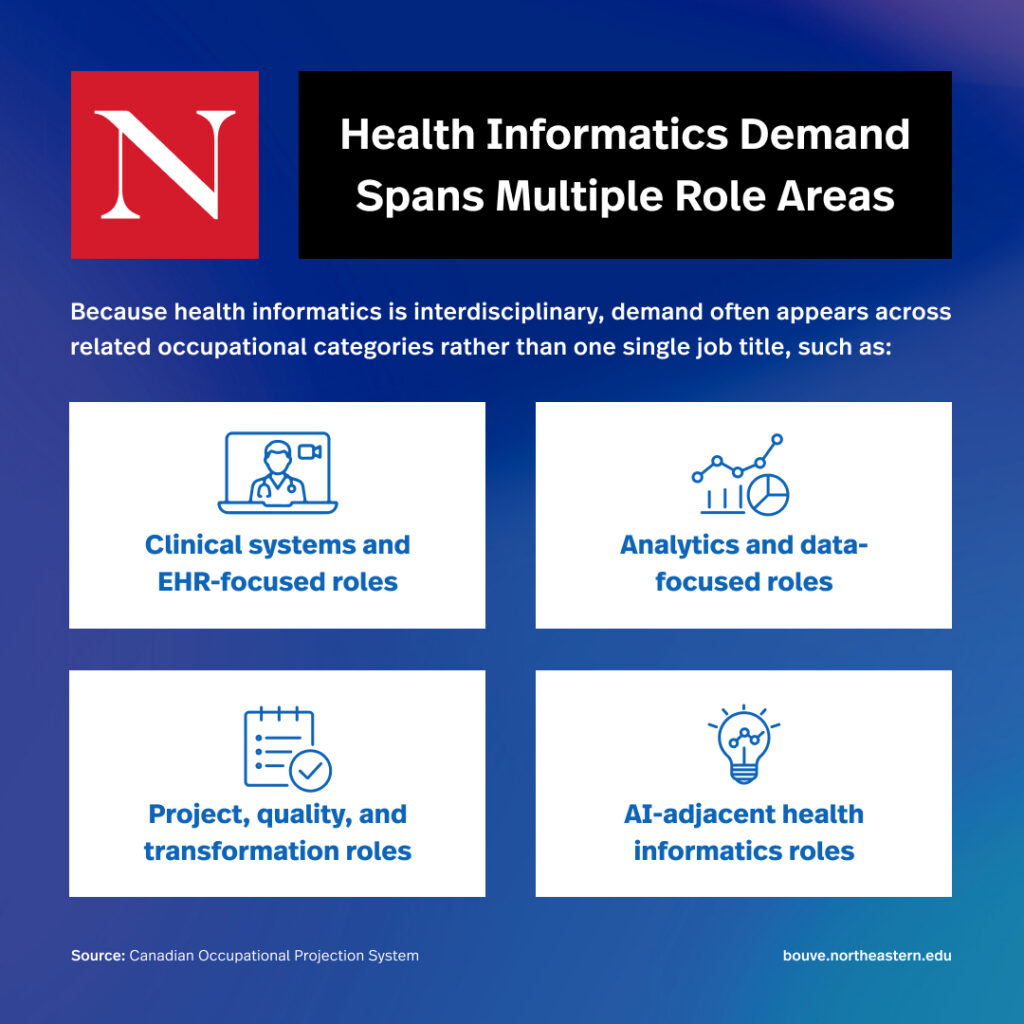
Clinical Systems and EHR-Focused Roles
Professionals who specifically train for the clinical informatics careers are likely to start out in system implementation and optimisation work. Many organizations are still in the early stages of digital transformation, and they’re figuring out how to manage EHRs, restructure information systems, and incorporate machine learning all at once.
Demand for clinical systems and EHR-focused roles is also reflected in broader employment projects. For instance, COPS projects 2,900 openings for health information management occupations from 2024 to 2033, while WorkBC describes these professionals as working across hospitals, clinics, healthcare establishments, and health record consulting firms.
Here are some of the most in-demand clinical informatics jobs within the core discipline.
- • Clinical informatics analyst: Analysts may set up and maintain EHR systems to improve data coordination and protect sensitive information. They also use data analysis, modeling, and reporting to develop more efficient healthcare workflows.
- • Clinical informatics specialist: Clinical informatics specialists often help healthcare teams use digital systems more effectively by supporting implementation, workflow improvement, training, reporting, and system adoption.
- • Systems analyst: Coming from an IT background, systems analysts may focus on improving the computing infrastructure and data-sharing processes for healthcare organizations. They evaluate organisational needs in terms of workflows, security, and access, and configure data systems to meet those requirements.
Systems design and workflow optimisation roles continue to increase as the rapid introduction of tools like AI has created a skills gap. Much of the existing workforce in these areas has a clinical or technical background, but clinical informatics requires a more integrative approach.
Analytics and Data-Focused Roles
Data analytics careers focus on data-driven decision-making through data engineering, evaluation, and reporting. Such roles project to continue their high-demand status, with COPS projecting 10,000 openings for data scientists from 2024 to 2033. While not every health data role uses the same title, these categories point to ongoing demand for professionals who can structure, analyse, and communicate complex data.
Possible roles in this area include:
- • Health data analysts: Raw data is dense and unstructured. Health data analysts may collect information and process it into structured formats that can be interpreted, modeled, and evaluated to produce helpful insights.
- • Reporting/BI-oriented roles: Data reporting involves translating data insights into actionable information that healthcare stakeholders can understand. This can involve visualisation models, diagrams, statistics, written reports, and more.
- • Programming, data integration, and business intelligence: Data engineering roles use software like SQL and Python to code databases and create custom algorithms for integrating and retrieving data. Many jobs rely on tools like Tableau and Power BI to create interactive visualisations to report on data trends and track KPIs.
Data communication can make or break healthcare operations because business intelligence is necessary to identify roadblocks, manage costs, and allocate resources well. Data analytics professionals must be able to accurately communicate the stakes involved in key decisions, whether positive or negative.
Project, Quality, and Transformation Roles
Outside of core health informatics roles, the industry has many support functions that still require niche expertise. For example, what are the legal implications of using AI in healthcare? What measures have to be taken to write new government policies that protect public wellbeing while encouraging research and development?
Important roles in project management and quality improvement include:
- • Project manager: Across all organizations, project managers oversee specific departmental operations and goals, coordinating staff, workflows, and resources to achieve desired outcomes.
- • Quality improvement lead: To ensure continual process improvement, quality assurance professionals use data to study the effectiveness of different workflow structures. They also strategize on how to make changes, reduce errors or security vulnerabilities, and consistently produce better results.
- • Digital transformation support roles: Digital transformation involves big-picture planning to overhaul information systems that are inefficient and improve public outreach through better technology.
- • Public-sector opportunities in Canada: Working within government agencies, informatics specialists can shape public health initiatives and influence the interplay of technology with healthcare, ethics, legal compliance, and training.
Project, quality, and transformation roles are harder to isolate as health informatics titles, but they sit within two areas where demand is clear: healthcare and project-based systems change. COPS projects that health occupations will record the strongest employment growth among broad occupational categories from 2024 to 2033, while Job Bank lists hundreds of current project manager postings across Canada.
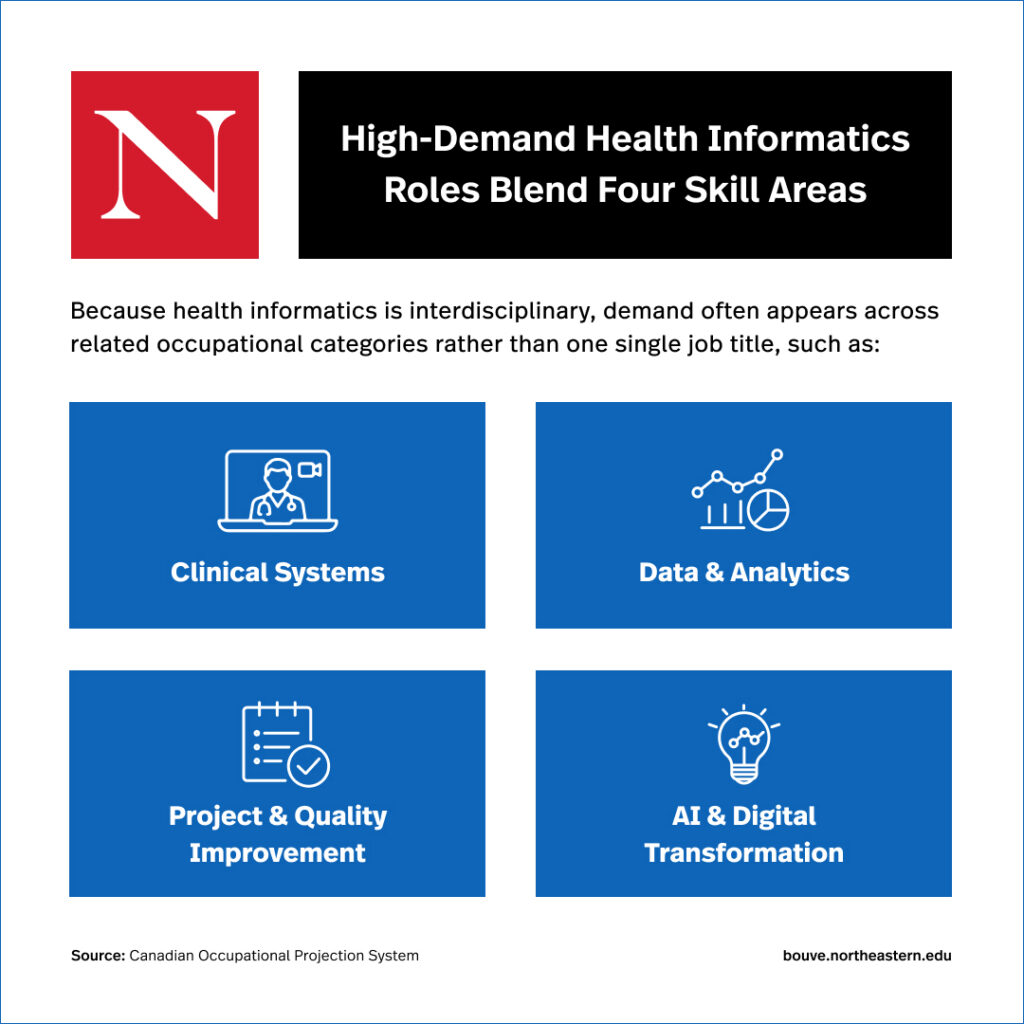
How AI is Impacting Health Informatics Roles
AI tools are being implemented in nearly every industry, making an understanding of these systems—how they can be used as valuable tools throughout the healthcare sector—an important part of future career resilience for professionals in health informatics. Many roles will increasingly use the technology for workflow optimisation and data modeling.
At the same time, AI regulation is still in flux and the pace of adoption is slower in healthcare due to security and ethical concerns. Professionals who are knowledgeable about health data protection laws and compliance standards can take the lead in developing AI implementation guidance.
How to Prepare for These Growth Areas
Building well-rounded technical skills along with domain expertise in healthcare is one of the best ways to prepare for health informatics careers. While there are several entry paths into the field, professionals with healthcare knowledge have more strategic insight and, therefore, offer more value to employers.
“I always tell some of my students, if you have a background in health informatics or in the healthcare industry in general, that is actually your superpower,” says Ryan Rad, Associate Director of the MS in Health Informatics-Vancouver program. “You understand AI and you understand the new technology, which is going to put you in a position that no one with a master’s or PhD of computer science can be.”
Rad also emphasizes the importance of learning core tools, such as EHR platforms, SQL, and Python. Professionals with these skills can enter the field through technical roles that require less clinical knowledge and gain real-world experience while training for more specialized jobs.
Learning to communicate with stakeholders is also crucial. The purpose of informatics is to shape decision-making in a purposeful way, which requires the ability to explain operational problems, strategic goals, and data trends. Informatics specialists have to be comfortable communicating data insights to professionals with different levels of technical understanding.
Consider pursuing a graduate education to deepen specialization and mobility. A master’s degree program targets all of these growth areas, giving graduates a competitive advantage as the industry evolves.
How Northeastern Prepares You for Success in Health Informatics
Bringing together all the diverse knowledge needed to understand information management and clinical operations normally takes significant time and exposure to different environments. Northeastern’s Master of Science in Health Informatics – Vancouver allows graduates to build upon their current experience and immediately start viewing information systems through a healthcare lens.
The program curriculum supports experiential learning in several ways. First, it combines technical, clinical, and project management education through course topics like epidemiology, health interface design, business intelligence, and public health surveillance.
Second, it incorporates a capstone project in which students partner with real companies to understand current operational challenges. Given the depth of the curriculum, students from non-technical or non-clinical backgrounds can apply and jumpstart their careers with a strong foundation in health informatics.
Depending on the roles you’re interested in, the degree can propel your career by preparing you to think strategically about interconnected issues like resource management, patient outcomes, and compliance.
As Rad notes, “For clinicians, like nurses, pharmacists, etc., the degree acts as a bridge to leadership positions where they can influence their systemic thinking with this new knowledge on working with data, with AI, with predictive modeling.”
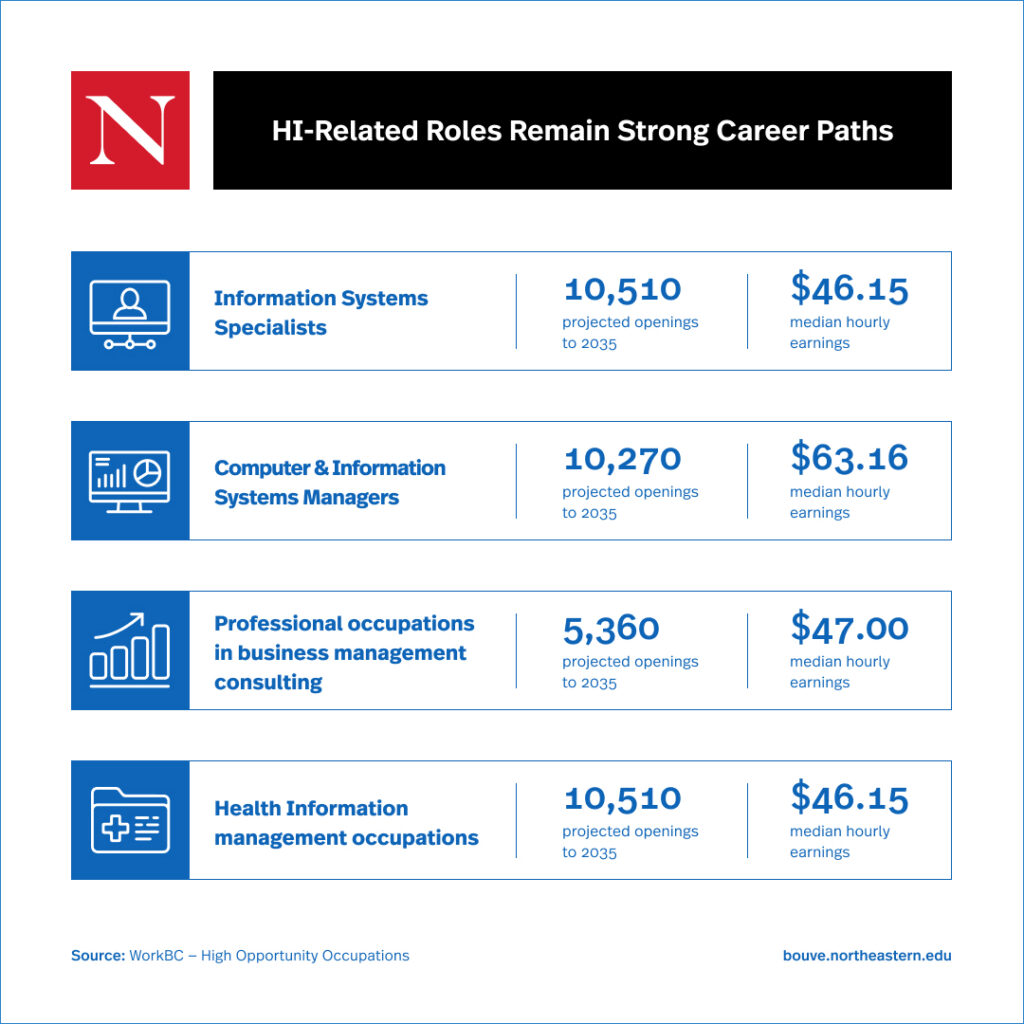
Stay Informed About Industry Standards and In-Demand Skills
The health informatics sector as a whole will continue to progress as clinicians, analysts, and engineers develop more data precision. Right now, there are still countless unanswered questions in healthcare, blind spots, and areas of improvement. New professionals entering the field can help the industry become better at refining data systems to support real-world scenarios and public health concerns.
For longevity in the field, it’s wise to think about skill expansion rather than specific job titles. Northeastern University’s MS in Health Informatics – Vancouver can equip graduates with the specialized expertise to advance in the field. Explore the program page to learn more about the curriculum and requirements or to request more information.