How Long Does a Master’s in Health Informatics Take — and Can You Work While Enrolled?
June 24, 2026

The field of health informatics continues to grow across Canadian healthcare sectors, attracting professionals who want to expand their opportunities and build long-term career stability.
Many people interested in entering the field are already working in healthcare, IT, analytics, operations, or another demanding profession. For them, fitting master’s-level study into an already busy schedule can feel daunting.
They are left to ask: can I fit this into my already-busy schedule?
The answer for many is yes, as the right health informatics graduate program can work around one’s personal and professional schedule to ensure that, with a bit of planning, it remains manageable.
For many working adults, programs that combine flexibility and structure—such as Northeastern University-Vancouver MS in Health Informatics program—are what make graduate study feel possible in the first place.
Here, we’ll examine exactly what kind of a timeline you can expect while pursuing your master’s in health informatics, and how you should plan to fit your studies into an already-busy schedule.
Key Takeaways
- • A master’s in health informatics can vary in length, but Northeastern’s Vancouver MSHI is designed to be completed in 18–24 months.
- • The program offers both part-time and full-time study options, giving students more than one way to manage their timeline.
- • Because the program is delivered online for domestic Canadian students, it may be possible to keep working while enrolled.
- • Flexibility matters to many Canadian graduate students, especially those balancing work, family, and other responsibilities.
- • A manageable format does not mean less rigour: applied learning components such as the capstone still help connect coursework to real healthcare challenges.
How Long Does a Master’s in Health Informatics Usually Take?
There is no one universal timeline for every master’s in health informatics. Some programs are designed primarily for full-time students. Others are built with working professionals in mind.
That is why it helps to think not just in terms of, “How many months will this take?” but, more importantly, “What pace can I realistically manage?”
Northeastern’s MS in Health Informatics program, at their Vancouver campus, is an example of a program designed to offer multiple avenues to completion:
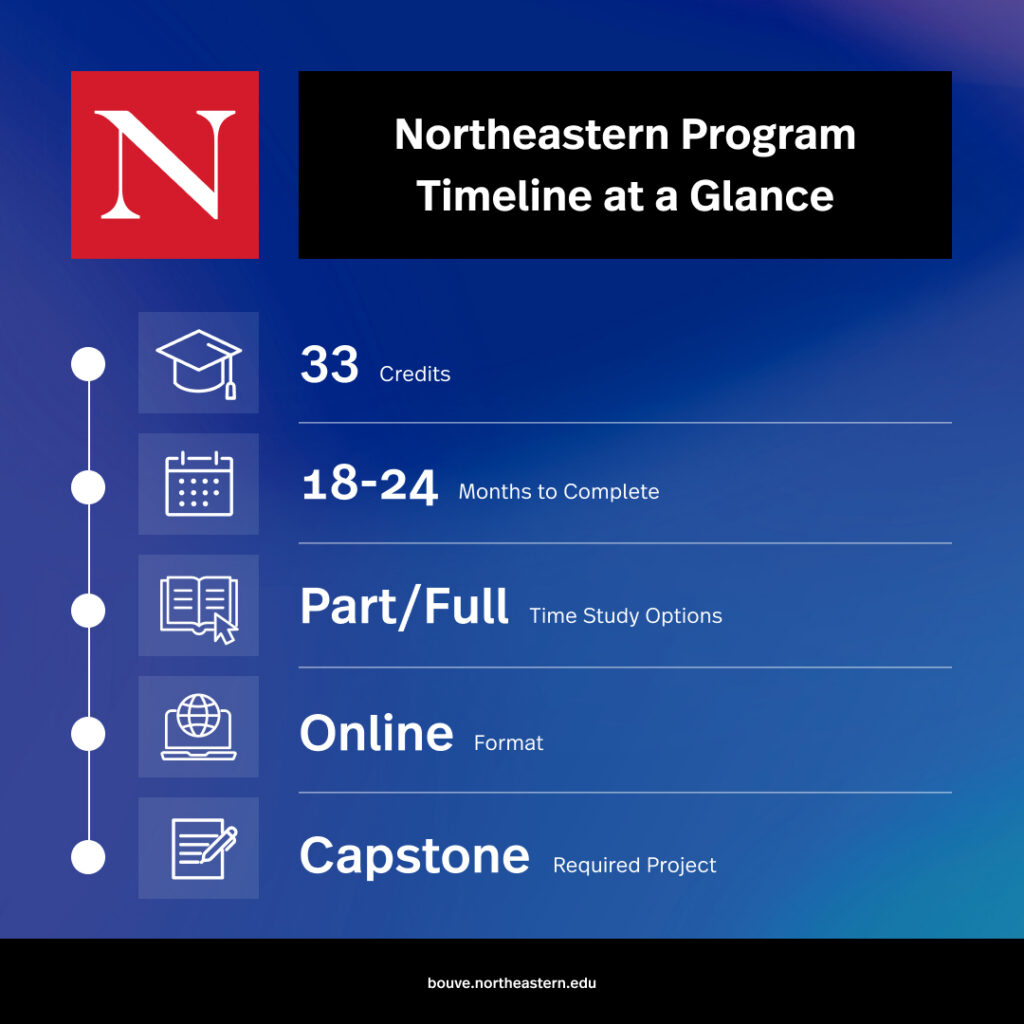
- • 33 total credits
- • 18–24 months to complete
- • Part-time and full-time study options
- • Online delivery
- • Fall and spring entry terms
That gives prospective students more than one possible path through the program. Someone studying full time may move more quickly, while someone balancing work or family responsibilities may decide to spread coursework out over a longer period.
That practical flexibility is one reason the degree can appeal to adult learners who want to build new expertise without completely stepping away from their current career.
Can I Really Still Work While Pursuing My Master’s?
The answer is often yes, depending on the program structure, your schedule, and how much coursework you can realistically take on at one time.
Flexible full- and part-time options are no longer simply a convenience. They can shape the entire return on investment of a graduate degree.
If you can continue working while studying, you may be able to:
- • Keep building professional experience
- • Continue earning income
- • Apply what you learn in real time
- • Reduce the opportunity cost of going back to school
At Northeastern, the program is offered fully online, though Ryan Rad, Associate Director of the MS in Health Informatics-Vancouver program, noted that the longer-term direction is to move toward a hybrid option for Canadian students.
With flexibility built into the options offered, Rad states that students can often work “part-time or full-time” while pursuing their degree.
That does not mean the program is easy or light. It means it is structured with adult learners in mind.
Why Flexibility Matters More Than Ever for Graduate Students
According to the 2024 Pan-Canadian Report on Digital Learning, Canadian colleges and universities expect digital learning to keep expanding. Among institutions surveyed:
- • 73% expected more hybrid offerings
- • 62% expected more fully online offerings
- • 52% expected more fully in-person offerings
- • 51% expected more multi-access offerings
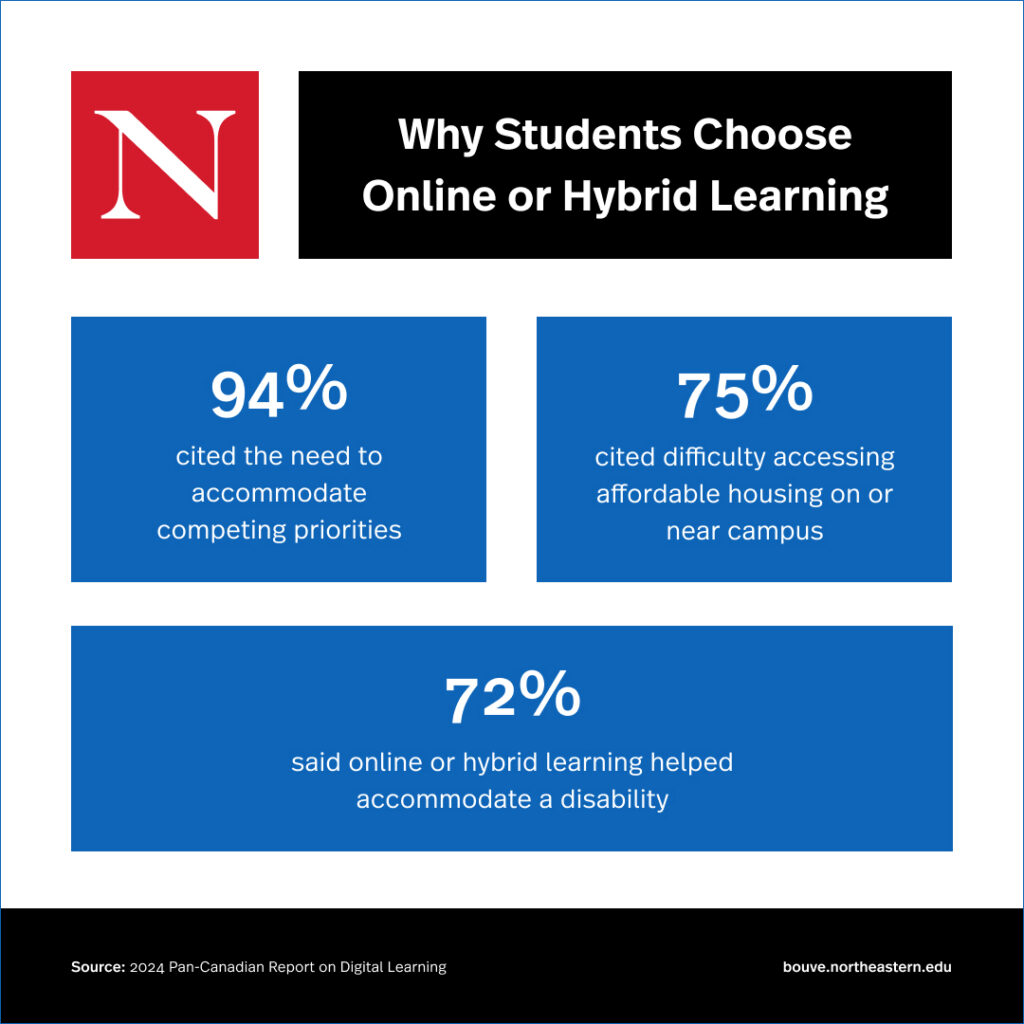
The same report found that students often choose online or hybrid learning because it helps them manage competing priorities. Among surveyed students:
- • 94% cited the need to accommodate competing priorities
- • 75% cited difficulty accessing affordable housing on or near campus
- • 72% said online or hybrid learning helped accommodate a disability
Put plainly, flexibility is no longer a niche feature. For many students, it is what makes graduate study accessible at all.
That is especially relevant for health informatics, where many prospective students are already working professionals who want to advance without putting the rest of life on hold.

What Flexible Learning Often Looks Like in Practice
Flexibility can mean different things from one program to another.
In some cases, it means taking one course at a time. In others, it may mean studying online while working full time, or adjusting course load depending on your schedule.
The MS in Health Informatics at Northeastern University’s Vancouver campus can be especially useful for:
- • Working clinicians who want to move into informatics or leadership roles
- • Technical professionals who want to specialize in healthcare
- • Career changers who need a degree format that fits around other responsibilities
- • Students in B.C. or elsewhere in Canada who want a graduate credential without relocating
How Experiential Learning Fits Into the Schedule
A flexible graduate program still needs to do more than fit around your calendar. It also needs to prepare you for real work in the field.
That is where experiential learning becomes important.
Northeastern’s Vancouver MSHI includes a required capstone project, and the program is positioned as giving students a real-world application opportunity tied to Canadian healthcare challenges.
“So capstone is more of an internship in our program,” says Rad. “There are external companies that we bring in and they work with the students on some of their current challenges. And we also have official co-op placement. And there’s a huge support system in the Vancouver campus around helping our current students with co-op placement.”
That applied component matters for two reasons.
First, it helps students connect coursework to actual problems in healthcare systems, data workflows, and digital transformation.
Second, it can make the degree feel more immediately useful, especially for students who are already employed and want to apply what they are learning right away.
How to Decide What Pace Makes Sense for You
Different options will appeal to different individuals. A full-time pace may make sense if:
- • You want to complete the degree as quickly as possible
- • You have the time and financial flexibility to focus more heavily on school
- • You are trying to pivot into a new field on a shorter timeline
A part-time pace may make sense if:
- • You plan to keep working while enrolled
- • You have family or caregiving responsibilities
- • You want to reduce course load to make the program more manageable
- • You prefer to absorb technical and healthcare concepts at a steadier pace
There is no single “best” timeline. What matters most is whether the structure supports your goals and your reality.
Questions to Ask Before You Apply
If you are comparing programs, a few questions can help you make a more grounded decision:
1. How long does the program take at different paces?
Look for a clear range, not just a single number. And ensure the program offers the options and modality you’re comfortable with.
2. Can I work while enrolled?
A program that offers a part-time option will usually answer this more directly.
3. Is the format online, hybrid, or in person?
This can affect everything from commuting to housing to weekly scheduling.
4. How do applied learning components fit into the experience?
Capstones, internships, and co-ops can add major value, but you need to understand how they fit into the timeline and whether part-time pathways offer the same opportunities.
5. Is the program built for someone with my background?
Health informatics often attracts learners from healthcare, IT, analytics, operations, and project management. A program that explicitly supports interdisciplinary students may be easier to navigate.

So, Can a Master’s in Health Informatics Fit into My Schedule?
In many cases, yes — especially if the program is designed to support working adults.
For Northeastern’s Vancouver Master’s in Health Informatics program, the answer is built into the structure: online delivery, part-time and full-time options, and an 18–24 month timeline give students more than one way to move through the degree.
The courses will still be demanding and the work rigourous. Planning and understanding personal and professional limitations remain essential. But the right program is likely more manageable than many prospective students assume.
If you are looking for a program that can help you build expertise in health informatics without automatically requiring you to leave work behind, Northeastern University-Vancouver’s MS in Health Informatics may be the right option for you.